
Blog
Frankincense: the scent of temples, kings and caravans – history, production and properties of the essential oil

Midnight Mass, a winter evening, a church filled with a faint bluish haze. Almost everyone knows the scent that spreads through the air – resinous, warm, a little lemony. It is the scent of frankincense, one of the oldest fragrances we know. Three thousand years ago Egyptian ships sailed to the unknown land of Punt for it, camel caravans crossed the Arabian Peninsula, and Roman emperors spent fortunes on it.
In the third part of our essential oil series it is frankincense’s turn. After geranium and Virginia cedarwood this time we are not talking about leaves or wood but about resin – fragrant droplets the tree releases when its bark is cut. We look at the tree that grows from bare rock, how frankincense came to be and travelled through history, how resin becomes oil, what it contains and what is actually known about it.
Our frankincense essential oil is a 100 % pure oil from the resin of the Boswellia carterii tree from Somalia, obtained by steam distillation. Our range also includes Frankincense – fragrance blend 5 %, which is something quite different. This article is mainly about the pure oil; we have given the blend its own chapter at the end.

A name that tells a lot
The English word incense comes from the Latin incendere, to burn – the fragrant smoke that rises during religious rites. The more precise technical name is olibanum. It comes from the Arabic al-lubān, meaning “milk” – fresh resin flows from the tree milky white. The common English name frankincense comes from the Old French franc encens: pure, high-quality incense.
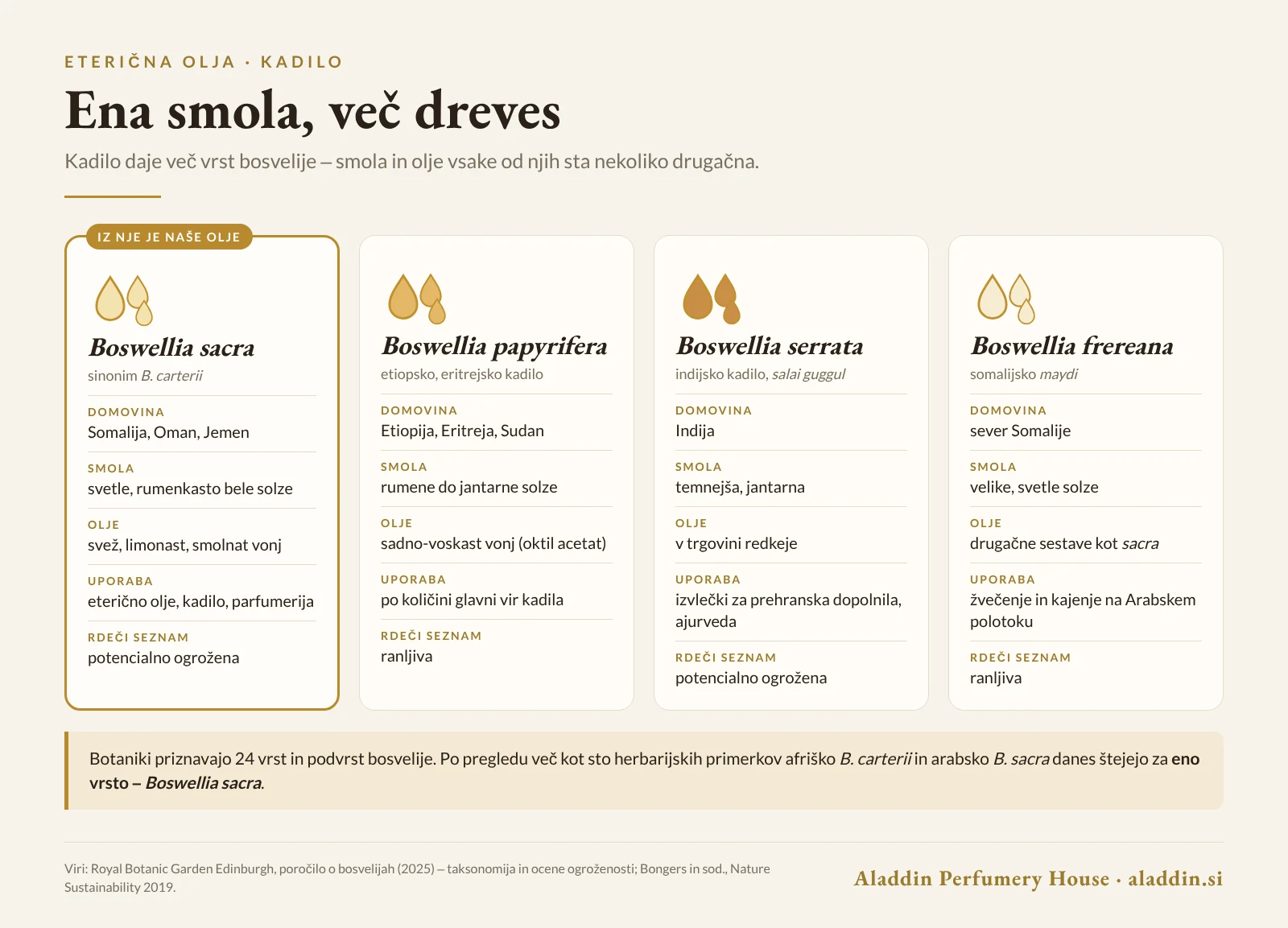
Frankincense comes from trees of the genus Boswellia (Boswellia) in the family Burseraceae, which also includes the tree that gives myrrh. Botanists today recognise 24 species and subspecies of Boswellia, but for trade the resin is collected mainly from four:
- Boswellia sacra (Somalia, Oman, Yemen) – the classic “Arabian” frankincense with a fresh, lemony scent. Our oil comes from this species.
- Boswellia papyrifera (Ethiopia, Eritrea, Sudan) – by volume the world’s most important source of frankincense today. Its oil smells different, fruity and waxy, because octyl acetate dominates.
- Boswellia serrata (India) – Indian frankincense or salai guggul. Its resin is used to make extracts for food supplements.
- Boswellia frereana (Somalia) – Somali maydi. On the Arabian Peninsula the resin is prized mainly for chewing.
Carterii or sacra?
Our bottle says Boswellia carterii, because this name has been used in the trade for Somali frankincense for over a hundred years. For a long time botanists considered the African B. carterii and the Arabian B. sacra to be different species. Researchers at the Royal Botanic Garden Edinburgh examined more than a hundred herbarium specimens and 37 characteristics but found no reliable difference between African and Arabian trees. Today it is therefore accepted that they are one species – Boswellia sacra, and the name carterii is its synonym. Nothing changes in the oil – only the name in the botanical books.
A tree that grows from bare rock
Boswellia sacra is a small, often multi-stemmed tree a few metres tall. Its bark is pale and peels in thin, papery flakes. The pinnate leaves sit at the ends of the branches and are shed in the dry season. The flowers are small, whitish to yellowish.
It grows in the harshest places in the Horn of Africa and southern Arabia – on limestone slopes in Somaliland and Puntland, in Oman’s Dhofar region and in Yemen’s Hadhramaut. With their swollen bases the trees cling to steep rocks and cliffs where there is hardly any soil and goats struggle to reach them. It is there, on hot, dry ground, that they give the most fragrant resin.
Frankincense is still collected almost entirely in the wild, not on plantations. For the trees this is becoming an ever bigger problem. An ecological study in Ethiopia, Eritrea and Sudan (2019) showed that in 18 of 23 populations of B. papyrifera there are hardly any young trees: seedlings are eaten by goats and camels, and trees are destroyed by fire and insects. The researchers predict that frankincense production will halve within twenty years. On the IUCN Red List of Threatened Species B. papyrifera is listed as vulnerable and B. sacra as near threatened. In Somaliland, too frequent tapping also exhausts the trees, so better protection of the frankincense trade is being discussed under the CITES convention as well.
History: from Egyptian temples to Midnight Mass
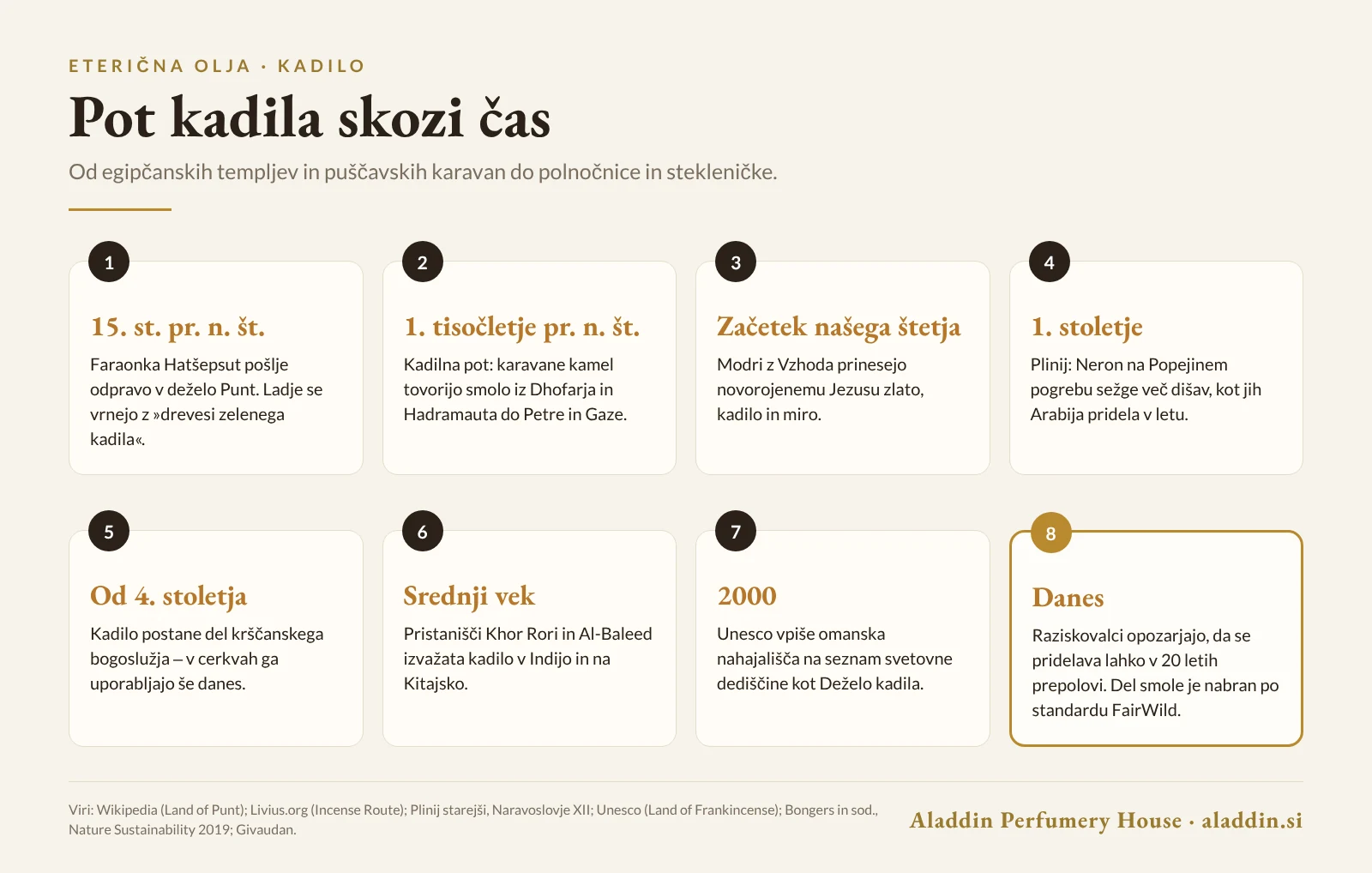
Frankincense was already burned in the oldest civilisations. In Egypt its smoke carried prayers to the gods, and the resin was an ingredient in fragrant blends and ointments. In the 15th century BCE the female pharaoh Hatshepsut sent an expedition to the land of Punt – probably on the coast of today’s Eritrea or Somalia. The ships returned with gold, ivory, ebony and “trees of green incense” to be planted at her temple. The expedition is depicted on reliefs at Deir el-Bahari.
In the first millennium BCE the Incense Routeemerged. Camel caravans carried the resin from Dhofar and Hadhramaut more than two thousand kilometres north, to Petra and the port of Gaza, from where it was shipped around the Mediterranean. The trade made the South Arabian kingdoms rich – including Sheba, the land of the legendary queen from the Bible.
The Romans used enormous amounts of frankincense – in temples, at sacrifices and at funerals. Pliny the Elder wrote that at the funeral of his wife Poppaea, Emperor Nero burned more fragrance than Arabia produces in a year. He also complained that Rome paid a hundred million sesterces every year for luxuries from Arabia, India and China.
Frankincense is one of the three gifts the Magi brought to the newborn Jesus – alongside gold and myrrh. The first Christians avoided frankincense at first because they associated it with pagan rites and the cult of the emperor. From the 4th century, however, it became part of the liturgy and remains so in the Catholic and Orthodox churches to this day. In the Middle Ages frankincense was exported from the Omani ports of Khor Rori and Al-Baleed to India and China. These ports, the desert oasis of Shisr and the valley of frankincense trees Wadi Dawkah have been on the UNESCO World Heritage List as the Land of Frankincensesince 2000.
From a cut in the bark to the bottle: how the oil is made
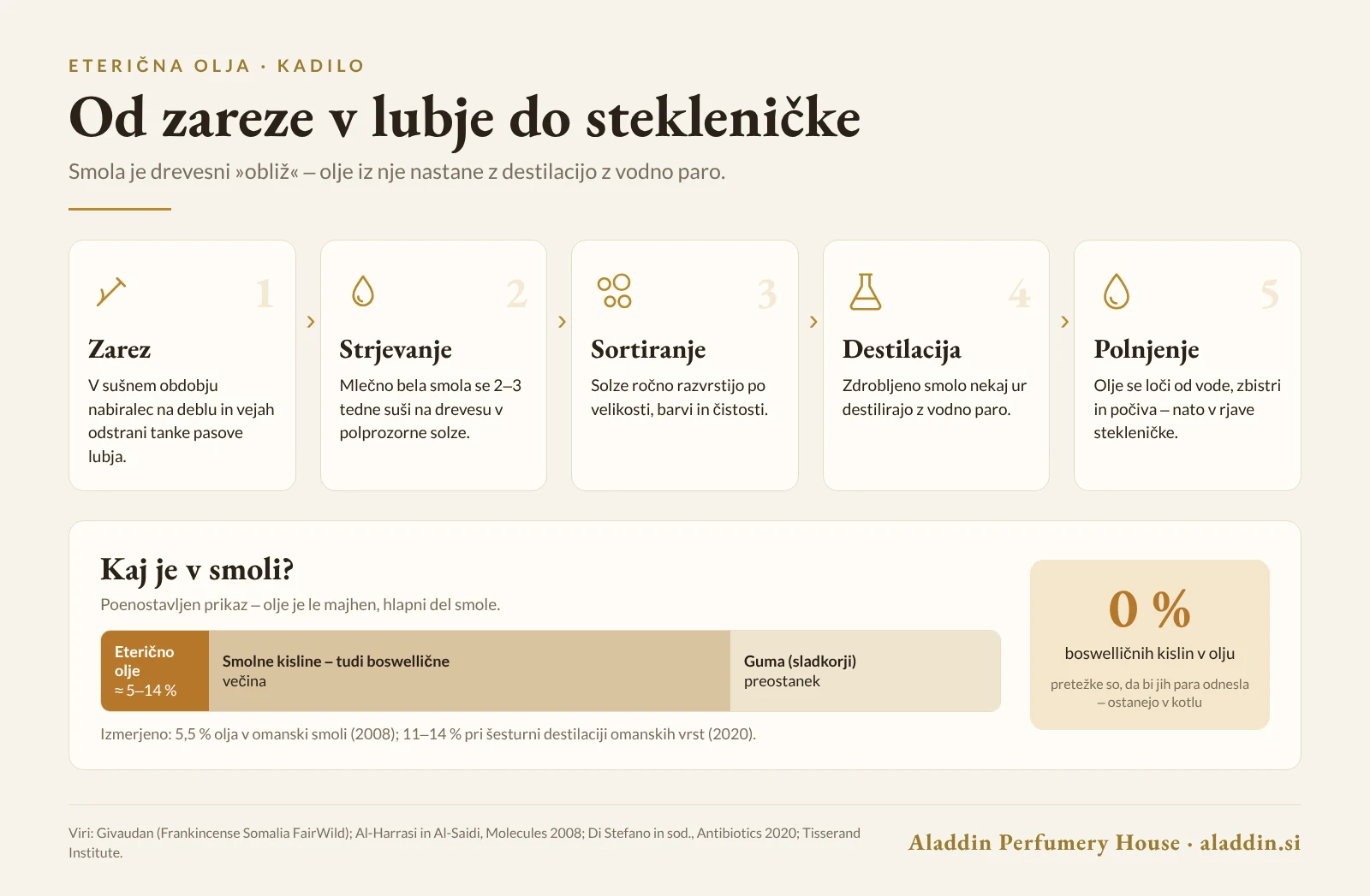
Resin is the tree’s “plaster”. When the bark is injured, the tree secretes a sticky, milky white sap that seals the wound and protects it from insects and fungi. Collectors make use of this: in the dry season, when the tree sheds its leaves, they remove a thin strip of bark in several places with a sharp scraper. Drops slowly flow from the wound and harden in the air into translucent tears.
- Tapping. In the dry season the collector removes thin strips of bark on the trunk and branches.
- Hardening. The resin dries on the tree for two to three weeks. It is then scraped off and the wound reopened – several times in one season.
- Sorting. The tears are sorted by hand by size, colour and purity. Lighter and larger tears are considered better – in Oman the Hojarigrade is the most prized.
- Steam distillation. The crushed resin is distilled for several hours with steam, which carries away the volatile substances.
- Separation and bottling. The steam condenses in the cooler, the oil separates from the water, clears and rests – then we fill it into brown bottles.
What stays behind in the still
Frankincense resin is a mixture of three parts: essential oil, non-volatile resin acids and gum, which resembles sugars in its composition. Oil makes up only a few per cent of it. In one analysis of Omani resin it was 5.5 %; with longer distillation of Omani grades 11 to 14 %. Everything else – including the famous boswellic acids – stays in the still, because the molecules are too heavy to be carried by the steam. This matters because you often read online that frankincense oil contains boswellic acids. It does not.
Because the trees grow in hard-to-reach places and the resin is collected by hand, pure frankincense oil is among the more expensive essential oils. Part of the Somali resin is now collected to the FairWildstandard, which requires that trees are not tapped too often and that collectors are paid fairly.
What is in a drop: the composition of the oil
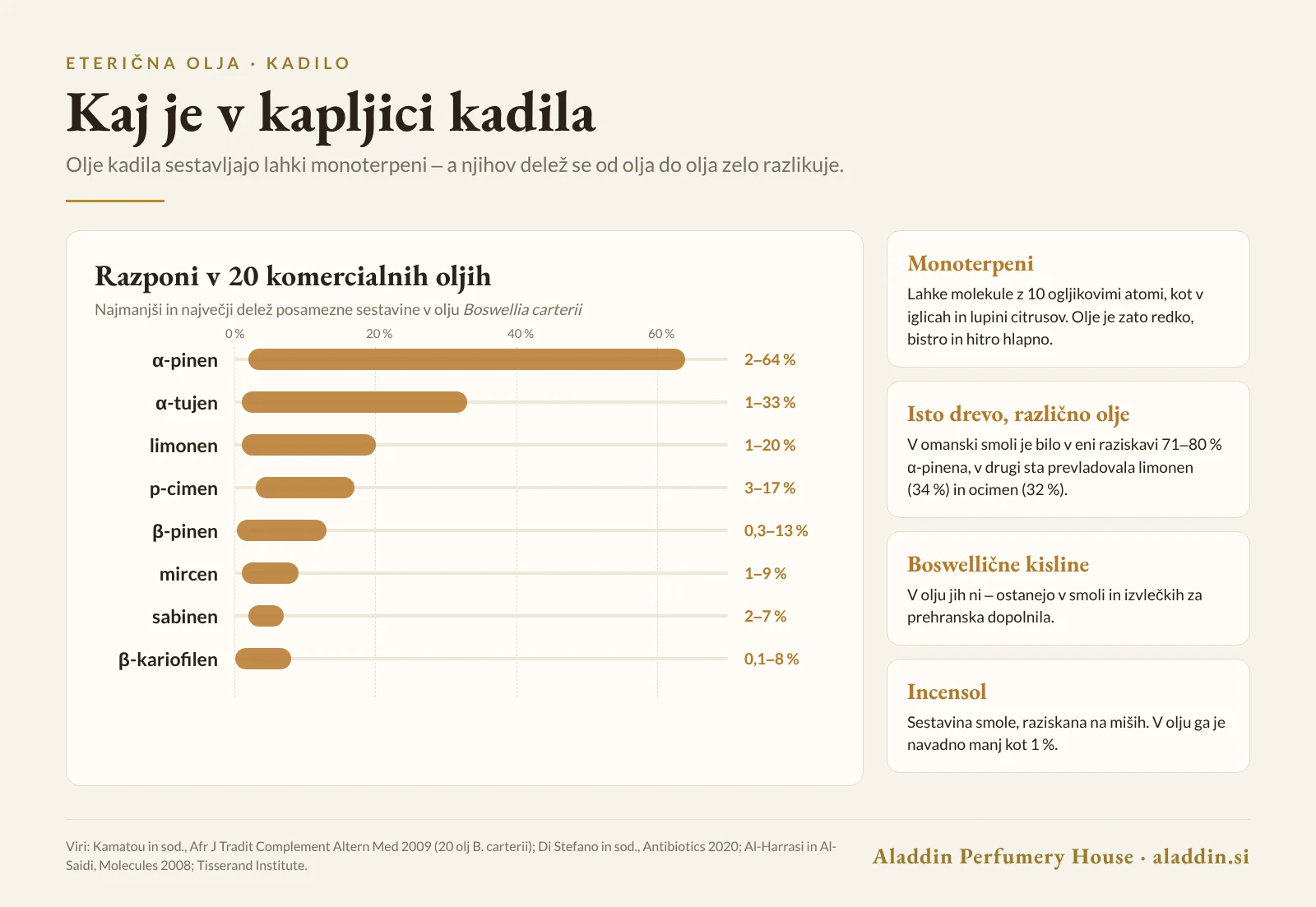
Frankincense oil consists almost entirely of monoterpenes – light molecules with 10 carbon atoms, also found in conifer needles and citrus peel. That is why the oil is thin, clear and evaporates quickly, and its scent is fresh and penetrating. The main constituents are:
- alpha-pinene – a resinous, needle-like scent, often the main constituent,
- alpha-thujene – a herbaceous, slightly woody note,
- limonene – a fresh, lemony scent,
- p-cymene, myrcene, sabinene and beta-pinene – warm, herbaceous and resinous nuances,
- beta-caryophyllene – a slightly peppery, woody nuance.
What is special about frankincense is how much the oils differ from one another. South African researchers analysed 20 commercial oils of Boswellia carterii: alpha-pinene ranged from 2 to 64 %, alpha-thujene from 1 to 33 %, limonene from 1 to 20 %. It is similar with Omani resin – in one study the oil contained 71 to 80 % alpha-pinene, in another limonene and ocimene dominated. The composition depends on the tree, location, year, quality of the tears and method of distillation. This is exactly why, with frankincense, it is important to buy oil from a supplier with a certificate of analysis.
How frankincense oil smells
Many people are surprised that frankincense oil does not smell like a church. The smoke in church comes from resin burning on charcoal – the non-volatile substances break down too, and the smoke gets its typical heavy, slightly burnt note. The oil, on the other hand, contains only what the resin releases without fire. That is why it is fresher: lemony, resinous and slightly peppery at first, then warm, balsamic and softly woody, with a barely noticeable hint of mint or camphor.
In perfumery frankincense is mainly a top and heart notethat gives a fragrance light, space and “stillness”. For a longer-lasting, deeper scent the resin extract (resinoid) is also used. Frankincense pairs beautifully with citrus oils, lavender, cedarwood, patchouli, ylang-ylang and geranium; with conifers it creates the scent of a forest chapel.
Frankincense is the scent of stillness – fresh as lemon, warm as resin and calm as an empty church.
Properties: what is proven, what is researched and what is folk tradition
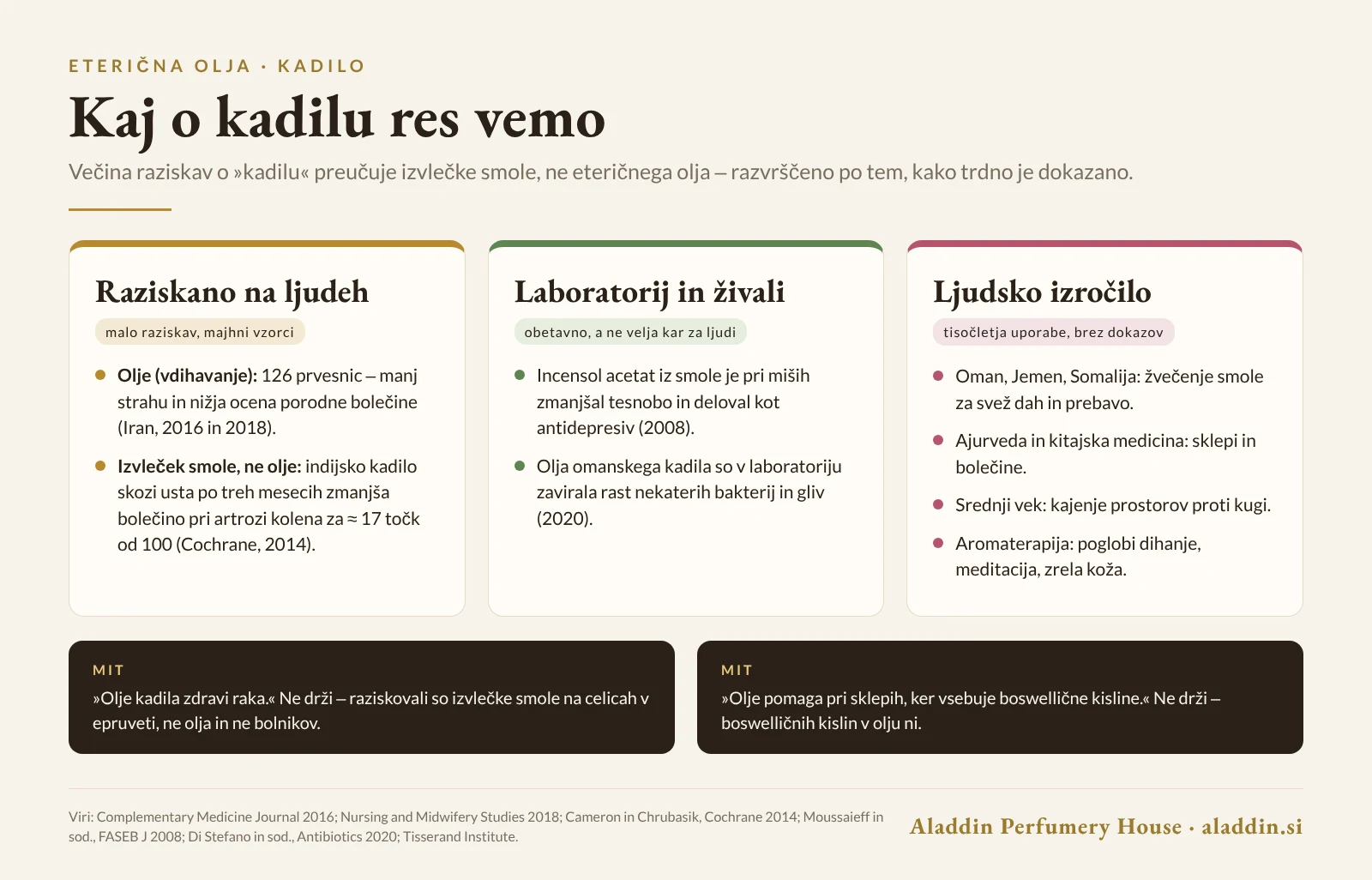
Frankincense has an exceptionally rich tradition and many studies, but here you have to pay particular attention to what is being discussed. Most scientific studies on “frankincense” do not examine the essential oil but resin extractstaken by mouth. These are two completely different products.
Researched in humans – with essential oil
- Less anxiety and pain during labour. In an Iranian study, 126 first-time mothers in labour had a gauze with diluted Boswellia carteriioil pinned to their collar, while the control group had gauze with saline. Women who inhaled the oil had less anxiety and rated their pain lower – at 3–4 cm dilation 5.0 instead of 6.7 points on a 10-point scale. The results were published in two articles (2016 and 2018) and have not yet been repeated elsewhere.
Researched in humans – with resin extract (not oil)
- Osteoarthritis. A Cochrane review (2014) found that an enriched extract of Indian frankincense (Boswellia serrata) taken by patients reduced knee osteoarthritis pain after three months by about 17 points on a 100-point scale. The evidence is of moderate quality. The effect is attributed to boswellic acids, which are not present in the essential oil – so these results cannot be transferred to the oil.
In the laboratory and in animals
- Incensole acetate. Israeli and American researchers isolated incensole acetate from frankincense resin. In mice it reduced anxiety and had an antidepressant effect via TRPV3 channels in the brain (2008). The substance was injected into the mice; the oil usually contains less than one per cent of it.
- Antimicrobial effect. Oils from Omani frankincense inhibited the growth of some bacteria and fungi in the laboratory (2020). This is a laboratory result and does not mean the oil cures infections.
Folk tradition and aromatherapy
In Oman, Yemen and Somalia frankincense resin is chewed – for fresh breath and better digestion – and in some places it is soaked in water that is then drunk. Frankincense smoke is used to scent the home, clothes and hair when guests arrive and on holidays. In Indian Ayurveda shallaki (Indian frankincense) is a remedy for the joints, and in Chinese medicine ru xiang one for pain. In medieval Europe rooms were fumigated with frankincense to prevent the spread of plague.
Aromatherapists describe frankincense as an oil that slows and deepens the breath, calms the mind and helps with meditation and prayer. They recommend it for tension, grief and sleeplessness, for mature skin and rejuvenation. These claims are based on experience and tradition, not on studies.
Two myths you can safely forget
- “Frankincense oil cures cancer.” Not true. Laboratory studies examined resin extracts and individual boswellic acids on cells in a test tube – not the oil and not patients. The essential oil contains no boswellic acids. No human study has shown that frankincense oil cures cancer.
- “Frankincense oil helps joints because it contains boswellic acids.” Not true. For osteoarthritis, extracts taken by mouth were studied. Boswellic acids are too heavy to be carried out of the resin by steam; at most traces remain in the oil.
How we use frankincense at home
Our 100 % frankincense oil is intended for scenting rooms. It creates a calm, collected atmosphere – for meditation, yoga, reading and evenings. It is an excellent base for blends: with citrus oils it becomes festive, with lavender soft, with cedarwood and conifers deep and woody.
- Ultrasonic diffuser: 3–5 drops per 100 ml of water (about 10–15 drops in a 300–400 ml tank).
- Waterless nebuliser: Pour the oil into the device’s bottle and screw it on.
- Scent stones, wooden beads or ceramics: 2–3 drops, repeat as needed.
The oil is flammable, so do not drip it onto candles, light bulbs or other hot surfaces. Air the room occasionally during use. For the living room the Urban diffuseris a lovely choice, for the bedroom the Himalayan salt night light. You can read more about calming oils in the guide Which essential oil for the evening.
Six frankincense blends for the diffuser
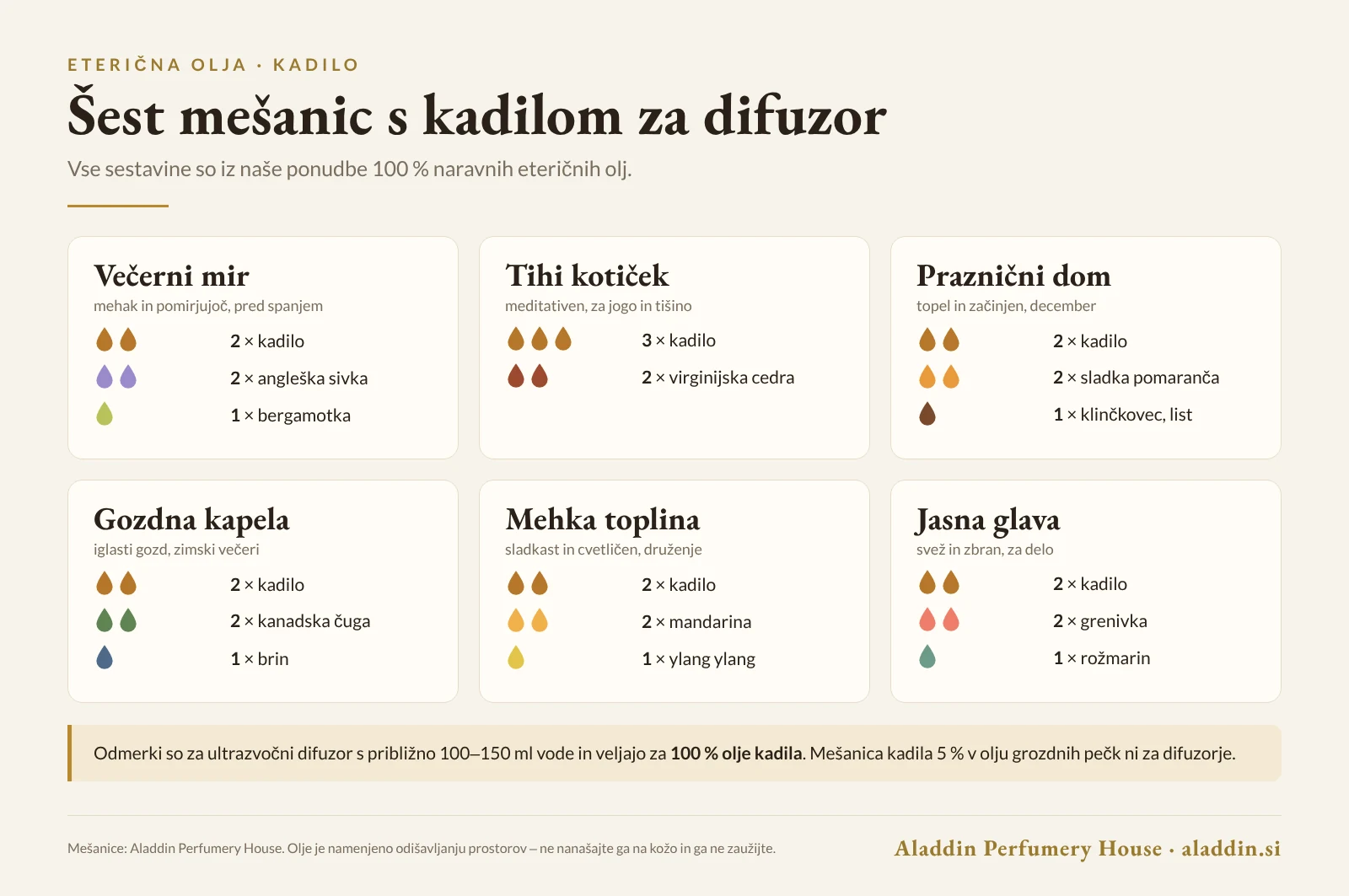
The following blends use only oils from our range; the amounts are for an ultrasonic diffuser with about 100–150 ml of water.
| Blend | Composition (drops) | When |
|---|---|---|
| Evening calm | 2 frankincense + 2 English lavender + 1 bergamot | Evening, before bed |
| Quiet corner | 3 frankincense + 2 Virginia cedarwood | Meditation, yoga |
| Festive home | 2 frankincense + 2 sweet orange + 1 clove leaf | December, guests |
| Forest chapel | 2 frankincense + 2 Canadian hemlock + 1 juniper | Winter evenings |
| Gentle warmth | 2 frankincense + 2 mandarin + 1 ylang-ylang | Company, relaxed evening |
| Clear head | 2 frankincense + 2 grapefruit + 1 rosemary | Work, study |
Tip: Frankincense is fresh and evaporates quickly, so it lasts longer in blends with cedarwood, patchouli or ylang-ylang. If you want a deeper, “church-like” tone, add a drop of patchouli.
 Frankincense 100 %Pure oil from resinView product
 Virginia cedarwoodThe perfect pair for meditationView product
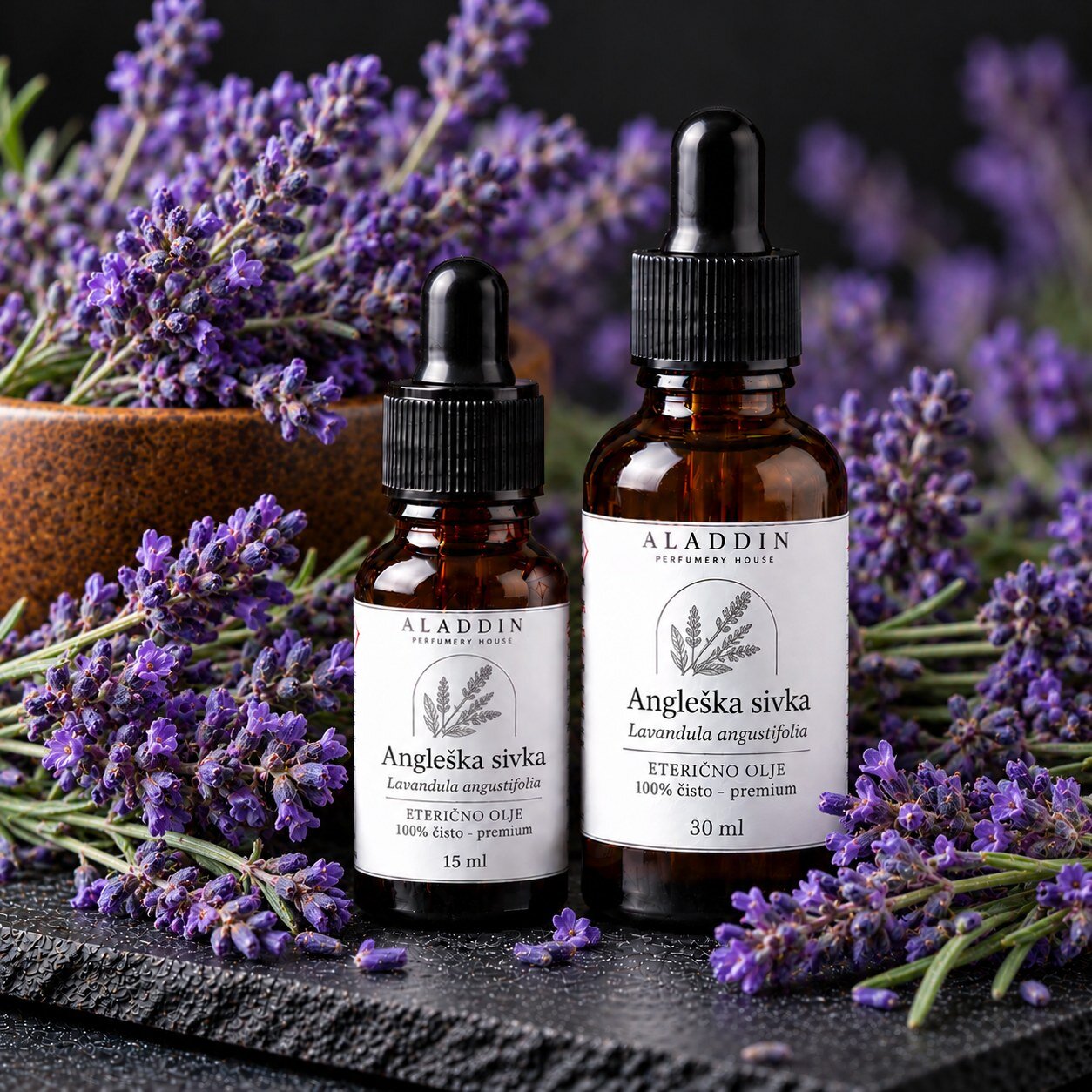 English lavenderFor calm eveningsView product
Frankincense 5 %: when the blend is practical
Besides the pure oil, our range also includes Frankincense – fragrance blend 5 %. This is not an essential oil but 5 % frankincense oil dissolved in grape seed oil. Its scent is therefore softer, more balsamic and unobtrusive, and the blend is more affordable. It is intended for passive scenting – without a device and without electricity.
| Frankincense 100 % | Frankincense 5 % | |
|---|---|---|
| Composition | 100 % essential oil from resin | 5 % frankincense oil in grape seed oil |
| Scent | intense, fresh, resinous | soft, balsamic, unobtrusive |
| Diffuser and nebuliser | yes | no – the fatty oil clogs the device |
| Scent stones, beads, ceramics | 2–3 drops | 3–4 drops |
| For blends | yes | not suitable |
| Signal word on the label | Danger | Warning |
Where the 5 % blend is practical:
- Yoga or meditation corner – a few drops on a scent stone or ceramic dish next to the mat.
- Bedside table and adults’ bedroom – a gentle scent that does not flood the room and needs no electricity.
- Desk and bookshelf – a wooden bead or stone you refresh once or twice a day.
- Bathroom, hallway and entrance – small rooms where a diffuser would be too strong.
- Wooden scent pendants – for example in the car or wardrobe, but so that it does not touch fabric.
- For anyone who does not yet know pure frankincense – a good first step before choosing the 100 % oil.
Because the blend contains fatty oil, do not drip it directly onto fabric, paper or untreated furniture wood – it can leave stains. Place the stone or beads on a small dish. Do not use the blend in an ultrasonic diffuser or nebuliser, because grape seed oil leaves an oily film and can clog or damage the device.
Safe use – a few rules to follow
- Do not apply the oil to the skin or take it internally. Our oil is not a cosmetic product but a pure concentrate for scenting rooms. Even though the resin is chewed in Arabia, the oil is something completely different – a highly concentrated substance.
- May be fatal if swallowed and enters airways. If someone swallows it by accident, do not induce vomiting and call the poison centre or a doctor immediately. Always keep the bottle out of the reach of children – it has a child-resistant cap.
- The oil is flammable (flash point 43 °C). Keep it away from candles, open flames and heat sources.
- On the skin it can cause irritation and allergic reactions, and serious irritation in the eyes. If oil gets into the eyes, rinse them carefully with water for several minutes.
- Monoterpenes such as alpha-pinene and limonene oxidise in air and light – oxidised oil causes allergic reactions more often. So always close the bottle tightly and store it cool and dark.
- Pregnant and breastfeeding women and parents of very young children should discuss use with a doctor. Do not use the diffuser in a room where a baby is sleeping.
- Pets: Cats are particularly sensitive to essential oils. While the diffuser is running, the animal should always be able to move to a scent-free room.
- The oil is very toxic to aquatic life, so do not pour leftovers down the drain.
- Aromatherapy does not replace medical treatment. If you have health problems, consult your doctor.
A safety data sheet is available for every oil, and we will email it to you on request. The label with all warnings can be found on the page of the pure oil and the 5 % blend.
Frequently asked questions
Are incense, olibanum and frankincense the same?
Yes. All three names refer to the resin of trees of the genus Boswellia and the oil obtained from it. Olibanum is the technical name, frankincense the common English one.
Does frankincense oil smell like church?
Not quite. In church the resin burns on charcoal, so the smoke is heavier and slightly burnt. The oil is fresher, more lemony and resinous, with a warm, balsamic background.
Does frankincense oil contain boswellic acids?
No. Boswellic acids are too heavy to be carried out of the resin by steam. They remain in the resin and in the extracts used in food supplements.
Are Boswellia carterii and Boswellia sacra the same tree?
According to recent botanical research, yes. Carterii is the name used in the trade for Somali frankincense; botanists now consider it a synonym of Boswellia sacra.
What is the difference between Frankincense 100 % and Frankincense 5 %?
Frankincense 100 % is pure essential oil for diffusers and blends. Frankincense 5 % is a solution in grape seed oil with a softer scent, intended for scent stones, wooden beads and ceramics.
Can I use Frankincense 5 % in a diffuser?
No. Grape seed oil leaves an oily film in ultrasonic diffusers and nebulisers and can clog or damage the device.
How many drops of frankincense oil should I put in the diffuser?
For an ultrasonic diffuser, 3–5 drops per 100 ml of water. Start with fewer and increase if needed.
Which oils pair best with frankincense?
Sweet orange, mandarin and bergamot, lavender, Virginia cedarwood, patchouli, ylang-ylang and geranium, and conifers such as Canadian hemlock and juniper.
A resin that connected the world
Few scents have a history as long as frankincense. Drops of resin from trees growing out of bare rock gave rise to kingdoms, caravan routes and ports, and frankincense smoke rose in Egyptian temples, Roman palaces and our churches. Today this history fits into a bottle – and it is up to us to use it with respect for the trees and for the people who collect the resin.
If you would like to get to know it, start simply: put three drops of frankincense and two drops of Virginia cedarwoodinto the diffuser. You will find the whole range in the category Pure essential oils. In the previous parts of the series we introduced geranium and Virginia cedarwood; how essential oils are made and how to recognise good quality is described in the article Essential oils: from plant to bottle.
In the next part of the series we will introduce another oil from our range. If you have any questions, write to us or call – we are happy to advise you.
Sources
- Royal Botanic Garden Edinburgh: Boswellia – conservation status, trade and threats (report, 2025)
- Bongers F. et al. (2019): Frankincense in peril – Nature Sustainability (summary by Wageningen University)
- UNESCO: Land of Frankincense (Oman)
- Wikipedia: Land of Punt – Hatshepsut’s expedition
- Livius.org: Incense Route
- Al-Harrasi A., Al-Saidi S. (2008): Phytochemical analysis of the essential oil from botanically certified oleogum resin of Boswellia sacra – Molecules 13(9)
- Di Stefano V. et al. (2020): In vitro antimicrobial activity of frankincense oils from Boswellia sacra grown in different locations of the Dhofar region – Antibiotics 9(4)
- Kamatou G. P. et al. (2009): Variation in essential oil composition of Boswellia carterii and its antimicrobial activity – Afr J Tradit Complement Altern Med
- Tisserand Institute: Does frankincense oil contain boswellic acid?
- Moussaieff A. et al. (2008): Incensole acetate, an incense component, elicits psychoactivity by activating TRPV3 channels in the brain – FASEB J
- Cameron M., Chrubasik S. (2014): Oral herbal therapies for treating osteoarthritis – Cochrane Database Syst Rev
- Effect of aromatherapy with Boswellia on anxiety in the first stage of labour – Complementary Medicine Journal 5(4), 2016
- Effect of inhaling Boswellia carterii oil on labour pain in first-time mothers – Nursing and Midwifery Studies 7(2), 2018
- Givaudan: Frankincense Oil Somalia FairWild


