

Blog
Lemongrass: the grass that smells of lemon and attracts swarms – history, production, properties and use in beekeeping

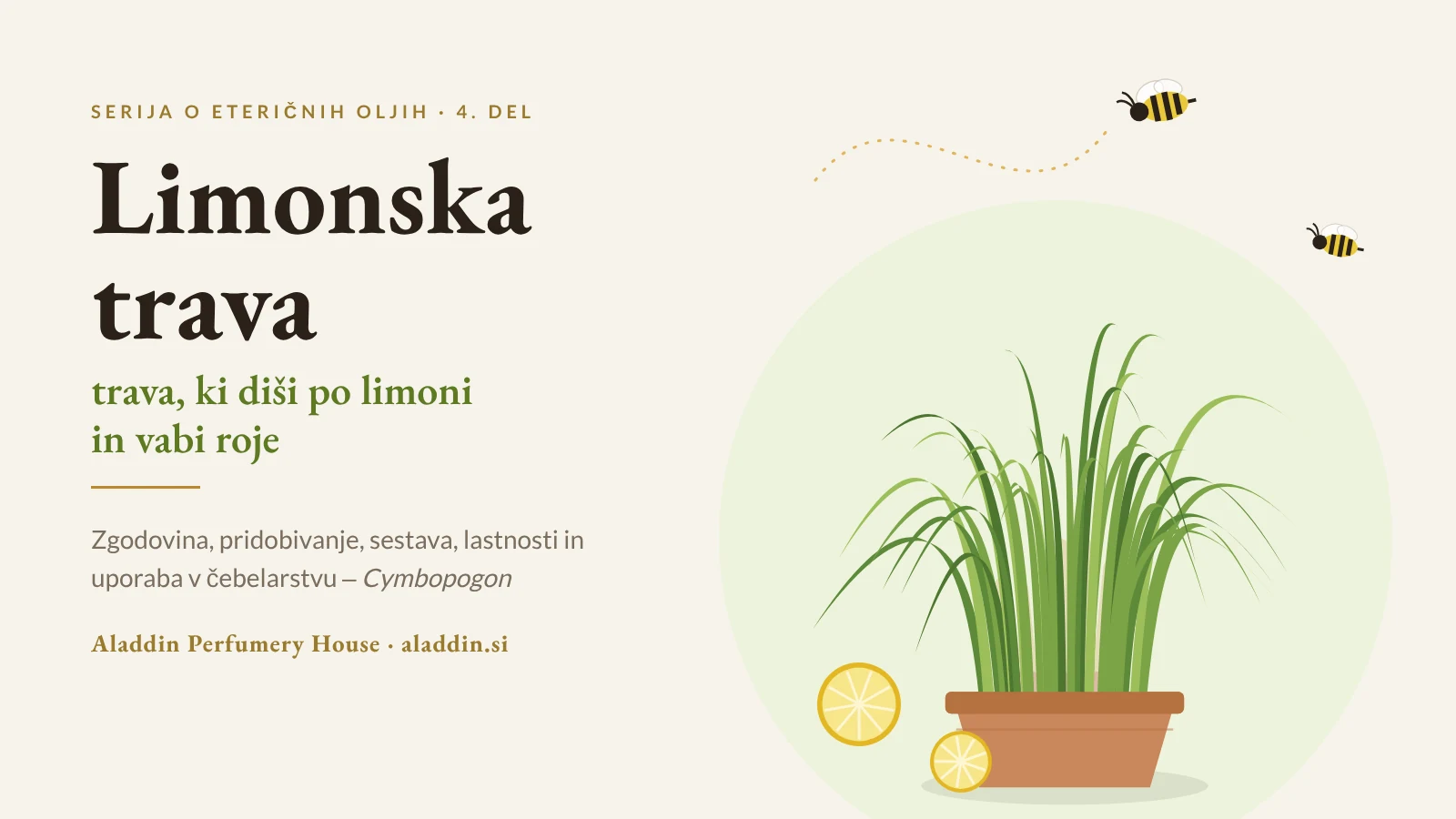
Anyone who has ever eaten Thai tom yum soup knows this scent: fresh, juicy, as if lemon had been mixed with freshly cut grass. It comes from a grass that grows up to one and a half metres tall and is cultivated on thousands of hectares in the tropics. For more than a hundred years its oil scented soaps and cleaners, provided the raw material for the first synthetically produced vitamin A, and beekeepers around the world use it to lure swarms into empty hives.
In the fourth part of our essential oil series it is the turn of lemongrass. After geranium, Virginia cedarwood and frankincense this time we turn to a grass – and to its fascinating connection with bees. We look at what the plant is like, how it travelled through history, how oil is made from it, what it contains, what is really proven and where it comes in handy: in the kitchen, in industry, in oral hygiene and in the apiary.
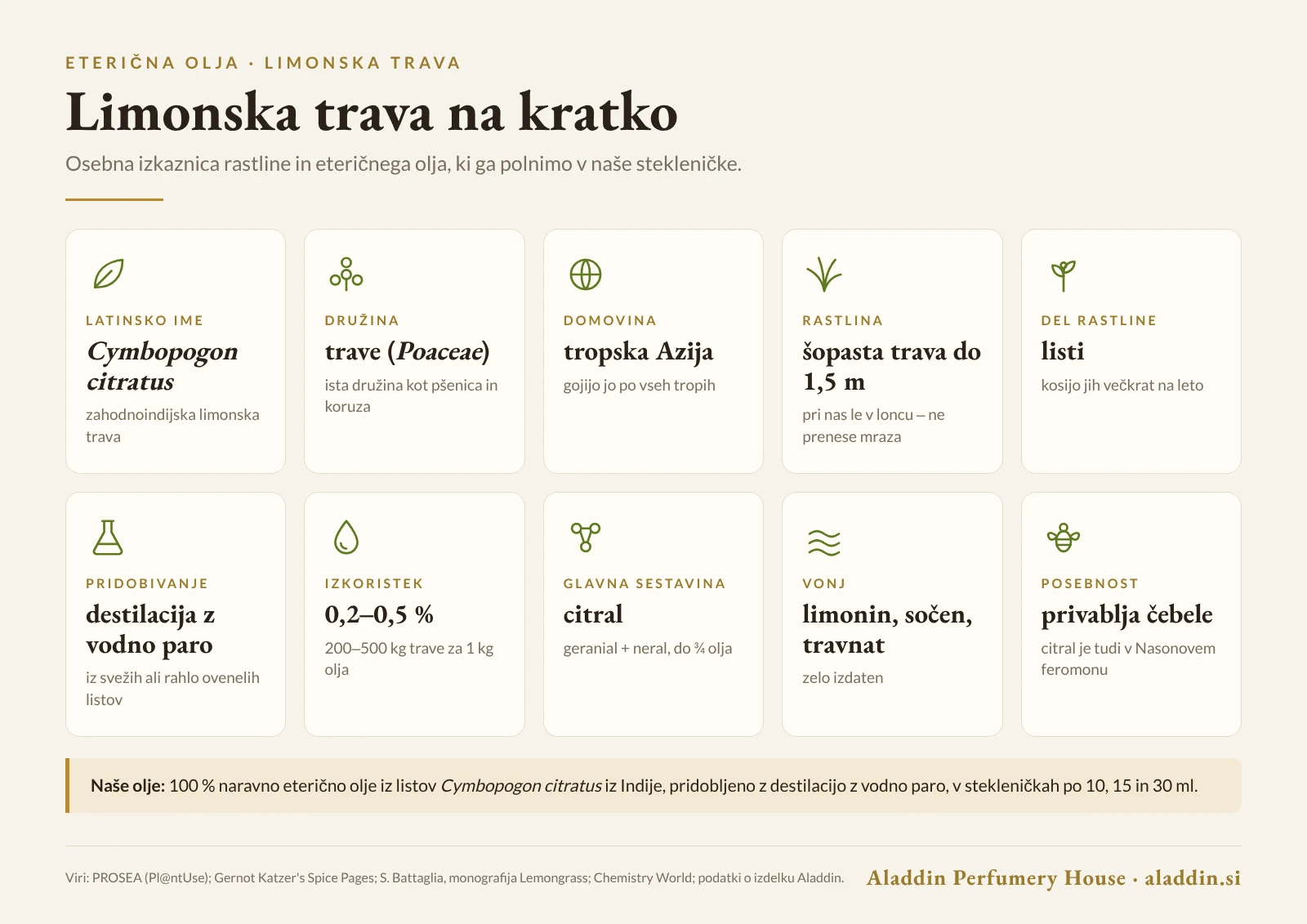
Our lemongrass essential oil is 100 % pure essential oil from the leaves of Cymbopogon citratus from India, obtained by steam distillation.
A grass with a beard and a boat
Lemongrass belongs to the genus Cymbopogon in the grass family (Poaceae) – the same family as wheat, maize and reed. The genus name comes from the Greek words kymbe (boat) and pogon (beard), because in most species the hairy spikelets peek out of boat-shaped bracts. The genus has around 50 species growing in Asia, Africa and Australia.
The plant grows in dense clumps from a short rhizome. The long, narrow leaves with sharp edges are blue-green and grow up to one and a half metres tall. The lower part of the stem is thickened, pale green to pink – this is the part we slice into soup in the kitchen. In a tropical climate lemongrass rarely flowers, so it is propagated by dividing the clumps.
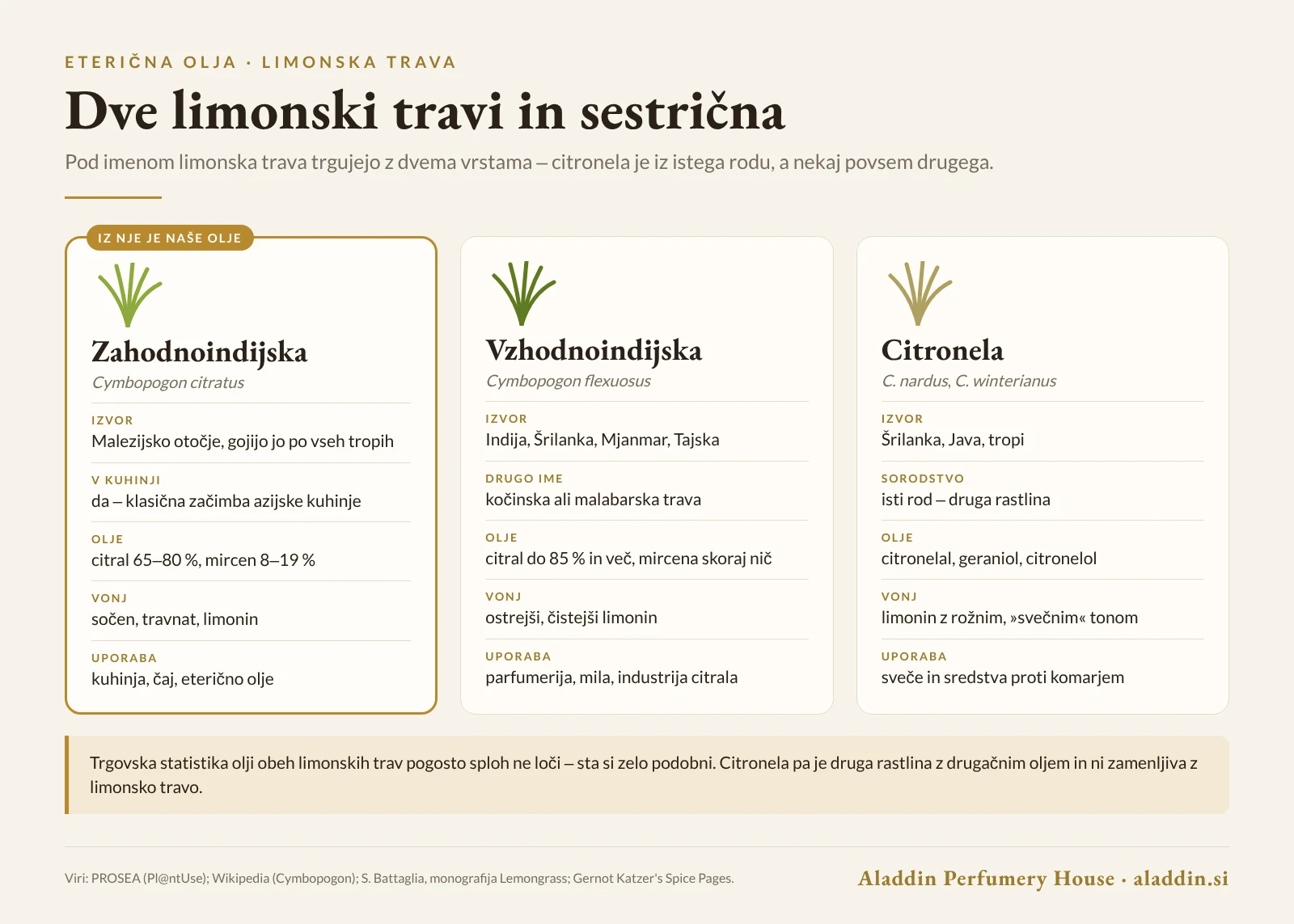
Two species that are easily confused are traded under the name lemongrass:
- West Indian lemongrass (Cymbopogon citratus) – probably originating in the Malay Archipelago but grown throughout the tropics: in Guatemala, Brazil, Madagascar, Vietnam and India. This is the “kitchen” species you can also buy at the greengrocer’s. Our oil comes from this species.
- East Indian lemongrass (Cymbopogon flexuosus) – native to India and Southeast Asia, also called Cochin or Malabar grass after the port of Kochi on the Malabar Coast, from where the oil was exported. Most of India’s oil production comes from this species.
The oils of the two species are very similar, and trade statistics often do not distinguish them at all. East Indian oil has slightly more citral and less myrcene, so it keeps better and is more valued in perfumery. Lemongrass should not, however, be confused with citronella (Cymbopogon nardus and C. winterianus) – a cousin from the same genus, but with a different oil, familiar from anti-mosquito candles.
Can you grow it at home?
Yes, but not outdoors over winter. Lemongrass does not tolerate frost, so in Central Europe it is grown in a large pot that stands on a sunny terrace in summer and in a bright, cooler room in winter. A bunch of fresh stems from the shop can even be rooted in a glass of water. It is of no use to bees as forage: it is a grass that hardly flowers in our climate and has no nectar. Bees are attracted by something else – its scent. More on this in the chapter on beekeeping.
History: from herb gardens to vitamin A
In South and Southeast Asia lemongrass has been used for centuries – as a spice, tea and remedy. In Indian Ayurveda it was used for fever, infections and to calm, in Chinese medicine for colds, headaches and stomach pain. In India hair was washed with water in which crushed leaves had been soaked. In Samoa and Tonga crushed leaves were used for inflammation in the mouth.
The Dutch still call it kamelhewe – “camel hay”, because according to tradition camel caravans carried dried grasses of this genus along the spice routes. In medieval European herbals it appears as squinant, an ingredient of spiced wines and beer – but this was probably a related desert species.
The genus Cymbopogon was named in 1815 by the German botanist Kurt Sprengel, and in 1906 the botanist Otto Stapf of the Royal Botanic Gardens, Kew, distinguished West Indian and East Indian lemongrass in his work on the “oil grasses of India and Ceylon”. By then oil from Kerala was already an important export.
The real turning point came in chemistry. The main constituent of the oil, citral, forms beta-ionone with acetone – a substance that smells of violets and is also a building block of vitamin A. In 1947 the Dutch chemists Jozef Arens and David van Dorp were the first to synthesise vitamin A, using citral as the starting material. Because supplies of lemongrass oil were not sufficient for industrial production – during the Second World War it was even scarce – companies developed synthetic routes. Germany’s BASF now produces citral from petrochemical raw materials and is one of the world’s largest producers of vitamin A.
In 1951 India began collecting and breeding lemongrass at Odakkali in Kerala and developed varieties with more than 85 % citral. In recent decades lemongrass has gained another role: beekeepers around the world have discovered that it can lure a swarm into an empty hive.

From mowing to the bottle: how the oil is made
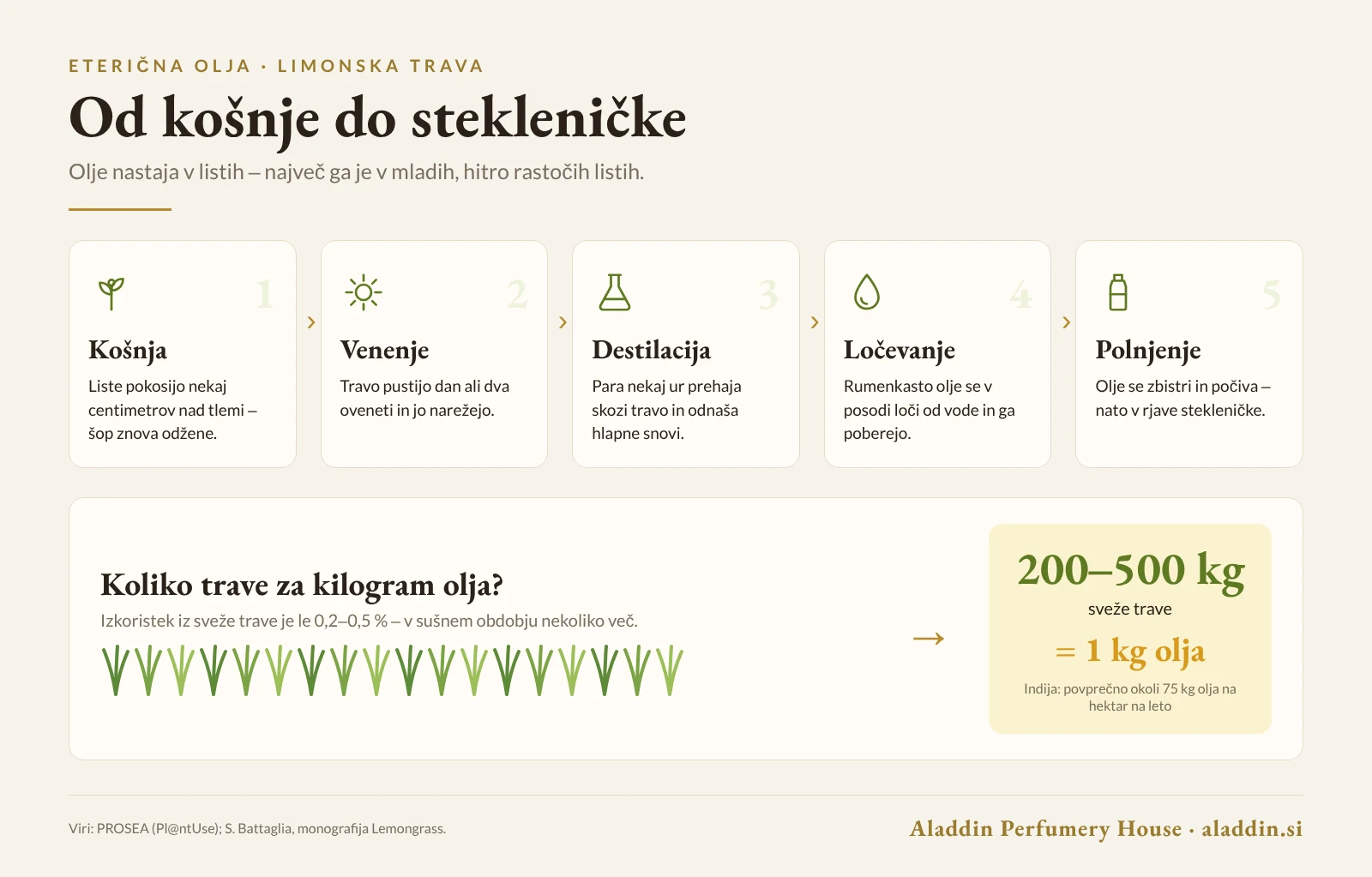
The oil forms in tiny cells in the leaves, most of it in young, fast-growing leaf blades. Lemongrass is therefore cut several times a year – first a few months after planting, then every few months, and a plantation yields for several years.
- Mowing. The leaves are cut a few centimetres above the ground so the clump regrows.
- Wilting. The cut grass is left to wilt for a day or two and chopped – this way more leaves fit into the still and distillation is more efficient.
- Steam distillation. Steam passes through the grass in the still for a few hours and carries away the volatile substances.
- Separation. In the condenser the steam turns to liquid, and the yellowish oil separates from the water and is skimmed off the top.
- Maturing and bottling. The oil clears and rests, then we fill it into brown bottles that protect it from light.
The yield is small: fresh grass gives only 0.2 to 0.5 % oil, a little more in the dry season. For one kilogram of oil, 200 to 500 kilograms of fresh grassmust therefore be distilled. In India one hectare yields on average around 75 kg of oil a year.
The residue after distillation does not go to waste: it is used as compost, fuel for the stills or raw material for paper. We have described how essential oils are made in more detail in the article Essential oils: from plant to bottle.
What is in a drop: the composition of the oil
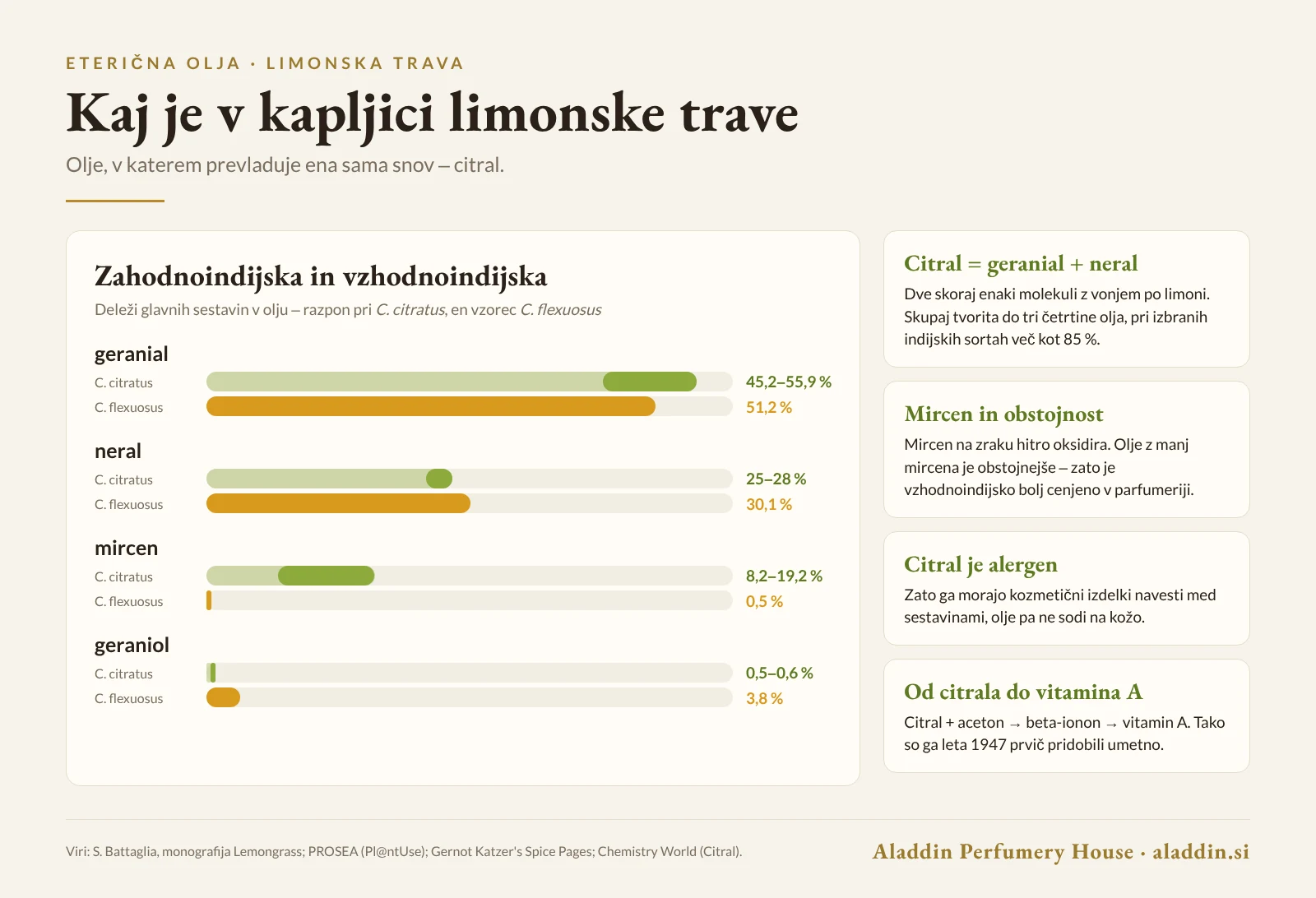
Lemongrass oil is one of the few oils dominated by a single substance. Up to three quarters of the oil, even more in selected varieties, is citral – a mixture of two almost identical molecules:
- geranial (citral A) – a fresh, sharp lemon scent, usually 40 to 56 %,
- neral (citral B) – softer, sweetish lemon, usually 25 to 35 %,
- myrcene – a herbaceous, slightly balsamic note; West Indian oil can contain 8 to 19 %, East Indian oil almost none,
- geraniol, geranyl acetate and linalool – floral, slightly rosy nuances.
Myrcene matters for a practical reason: it oxidises quickly in air, so oil with less myrcene keeps better. Citral is also the reason for the warnings on the label – it is a known allergen, so cosmetic products must list it among their ingredients, and the oil does not belong on the skin.
How lemongrass oil smells
The scent is intensely lemony, juicy and grassy, with a green, slightly herbaceous edge. Compared with real lemon it is less sour and more “green”, with a barely noticeable rosy hint of geraniol. It is one of the most powerful oils we know: just a few drops fill a kitchen or living room.
Because the scent is so strong, we use it in smaller proportions in blends. It pairs beautifully with citrus oils, geranium, lavender, tea tree, rosemary, Virginia cedarwood and ylang-ylang. In industry lemongrass oil has traditionally scented soaps, detergents and cleaners – the “fresh and clean” smell we know from the household often has exactly this origin.
Lemongrass is the scent of a tropical morning – lemon, dew and freshly cut grass in one drop.
Lemongrass and bees
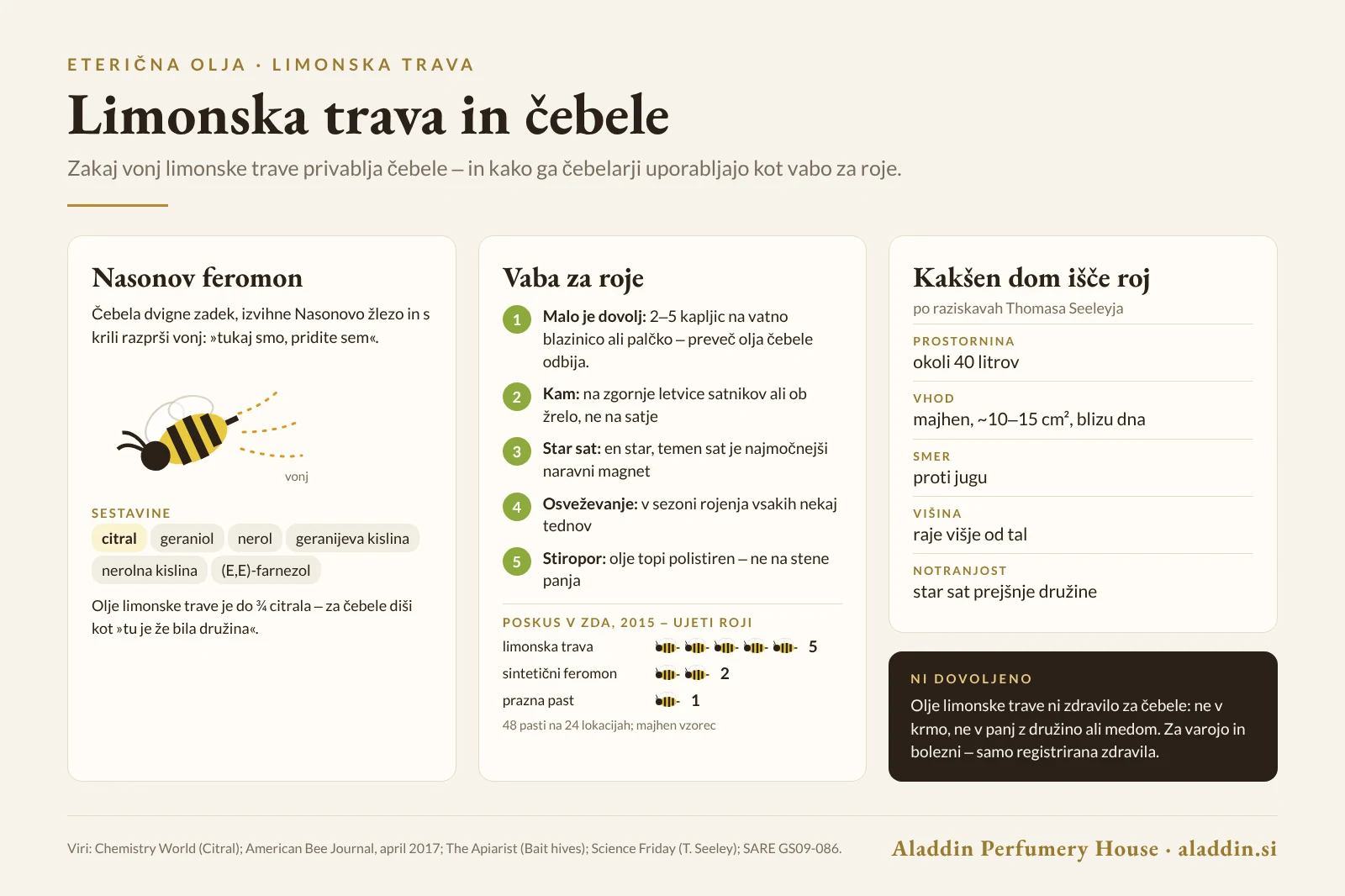
When a worker bee finds food, water or a new home, she raises her abdomen at the entrance, exposes the Nasonov gland and fans her wings to spread a scent that leads other bees to her. This is the Nasonov pheromone – “here we are, come here”. Its main constituents are geraniol, nerol, geranic and nerolic acid, and citral. Researchers found that citral alone attracts foraging bees.
Lemongrass oil is almost three quarters citral, so it has a similar effect – to bees it smells like “a colony has lived here”. That is why beekeepers around the world started using lemongrass oil as a swarm lure.
A lure for swarms
The Carniolan honey bee is fairly prone to swarming, and in Central Europe swarms most often appear from late April to June. Beekeepers set up a bait hive in or near the apiary – an empty hive that a swarm chooses as its new home. In an American field trial in 2015, 48 identical traps at 24 locations were compared: traps with lemongrass oil caught 5 swarms, traps with a commercial synthetic Nasonov pheromone 2 swarms, and empty control traps 1. The sample is small and the difference between lemongrass and pheromone is not statistically significant, but the author concludes that lemongrass oil is at least as effective as the synthetic pheromone.
How beekeepers do it in practice:
- A little is enough. A few drops of oil (2–5) on a cotton pad, a wooden stick or in a small container with holes. Too much oil repels – for a bee the scent is then too strong.
- Where. On the top bars of the frames or by the entrance, not directly on the comb.
- Combining with old comb. One old, dark comb in the bait hive is the strongest natural magnet for swarms. Lemongrass oil and old comb complement each other well.
- Refreshing. The scent evaporates slowly, so refresh the lure every few weeks during the swarming season.
- Careful with polystyrene. Essential oil dissolves polystyrene, so do not drip it directly onto the walls of polystyrene hives.
What kind of home a swarm looks for
American researcher Thomas Seeley spent decades studying how a swarm chooses its new home. A few hundred scout bees inspect possible cavities, and the swarm settles on the one that meets its criteria: a volume of about 40 litres, a small entrance (about 10–15 cm²) near the bottom, facing south, preferably higher off the ground and with old comb from a previous colony. A bait hive that meets these criteria has a much better chance – the lemongrass lure is just the icing on the cake.
Feeding and bee health
In the USA, additives for sugar syrup containing lemongrass and peppermint oils are sold to encourage bees to take up feed. A university trial in Tennessee (2009–2011) showed that in bees infected with Nosema such an additive reduced mortality but did not affect the number of Nosema spores. A few laboratory studies have also looked at the effect of lemongrass oil on Varroa mites, but the results are not reliable.
Where else lemongrass comes in handy
- In the kitchen – the fresh plant. The lower, thickened part of the stem is indispensable in Thai, Vietnamese and Indonesian cooking: in curry pastes, soups, marinades and teas. The stems are bruised before cooking to release their aroma and removed before serving. The essential oil, however, is not for cooking – a single drop is stronger than a whole bag of stems.
- In the flavour and fragrance industry. Citral from lemongrass gives citrus notes to soft drinks, sweets, soaps and detergents. It is also used to make ionones that smell of violets.
- In oral hygiene. In several clinical studies, mouthwashes with lemongrass oil reduced bad breath, plaque and gum inflammation. These are specially prepared, highly diluted products – never a matter of dripping oil into the mouth.
- On the terrace and in the garden. Lemongrass oil repels mosquitoes only weakly and briefly. For reliable protection choose an authorised repellent. In a diffuser on the terrace, however, lemongrass creates a pleasant summer atmosphere.
- In a clean home. The fresh scent of lemongrass is a classic in room-scenting blends after cleaning – in the kitchen, bathroom and hallway.
Properties: what is proven, what is researched and what is folk tradition
Lemongrass has a rich tradition and quite a few human studies – but almost all tested specially prepared products (mouthwashes, gels, tonics), not the scent from a diffuser. It is important to keep these apart.

Researched in humans
- Scent and tension. In a Brazilian study (2015), 40 men inhaled lemongrass oil, tea tree oil or water before a stress test. The lemongrass group reported less anxiety and tension immediately after the test, while attention remained unchanged. The effect was short-lived and the sample small.
- Oral hygiene. Mouthwashes with 0.25 % lemongrass oil reduced plaque and gum inflammation (60 adults, 2015) and bad breath (20 volunteers, 2015) in studies. In chronic periodontitis a 2 % lemongrass gel achieved an improvement similar to an antibiotic gel (40 patients, 2022).
- Scalp and skin. A tonic with lemongrass oil reduced dandruff within two weeks (30 volunteers, 2015). For a fungal skin infection (pityriasis versicolor), a lemongrass product was less effective than the standard drug ketoconazole (96 patients, 2013).
In the laboratory
- Antifungal and antibacterial. In the laboratory, lemongrass oil and citral inhibit the growth of Candida yeasts and many bacteria. These are laboratory results and do not mean the oil cures infections.
- Calming in animals. In mice lemongrass oil had a calming effect, which fits the tradition of a calming tea.
Folk tradition and aromatherapy
In Brazil lemongrass tea (capim-santo) is a traditional sedative – interestingly, a study with the tea in humans did not confirm a calming effect. In the Caribbean lemongrass is called “fever grass”, and in Asia it is drunk for digestion. Aromatherapists describe the oil as invigorating and refreshing: they recommend it for tiredness, poor concentration, freshening the air and in muscle blends – all based on experience, not on research.
Two myths you can safely forget
- “Lemongrass is the same as citronella and is excellent at repelling mosquitoes.” Not true. Citronella is a different plant with a different oil. Lemongrass oil repels mosquitoes only weakly and briefly – for reliable protection you need an authorised repellent.
- “Bees love lemongrass as forage.” Not true. Lemongrass is a grass that hardly flowers in our climate and has no nectar. Bees are attracted by the citral in its oil, which resembles their pheromone – so it is a good swarm lure, but not a honey plant.
How we use lemongrass at home
Our oil is intended for scenting rooms. It is powerful and cheerful – ideal for the kitchen after cooking, the bathroom, the workspace and summer evenings on the terrace.
- Ultrasonic diffuser: 3–5 drops per 100 ml of water – with lemongrass, start at the lower end.
- Waterless nebuliser: pour the oil into the device’s bottle and screw it on.
- Scent stones, wooden beads or ceramics: 2–3 drops, repeat as needed.
For the living room the Urban diffuseris a lovely choice, for smaller rooms the Himalayan salt night light. Air the room occasionally during use.
Six lemongrass blends for the diffuser
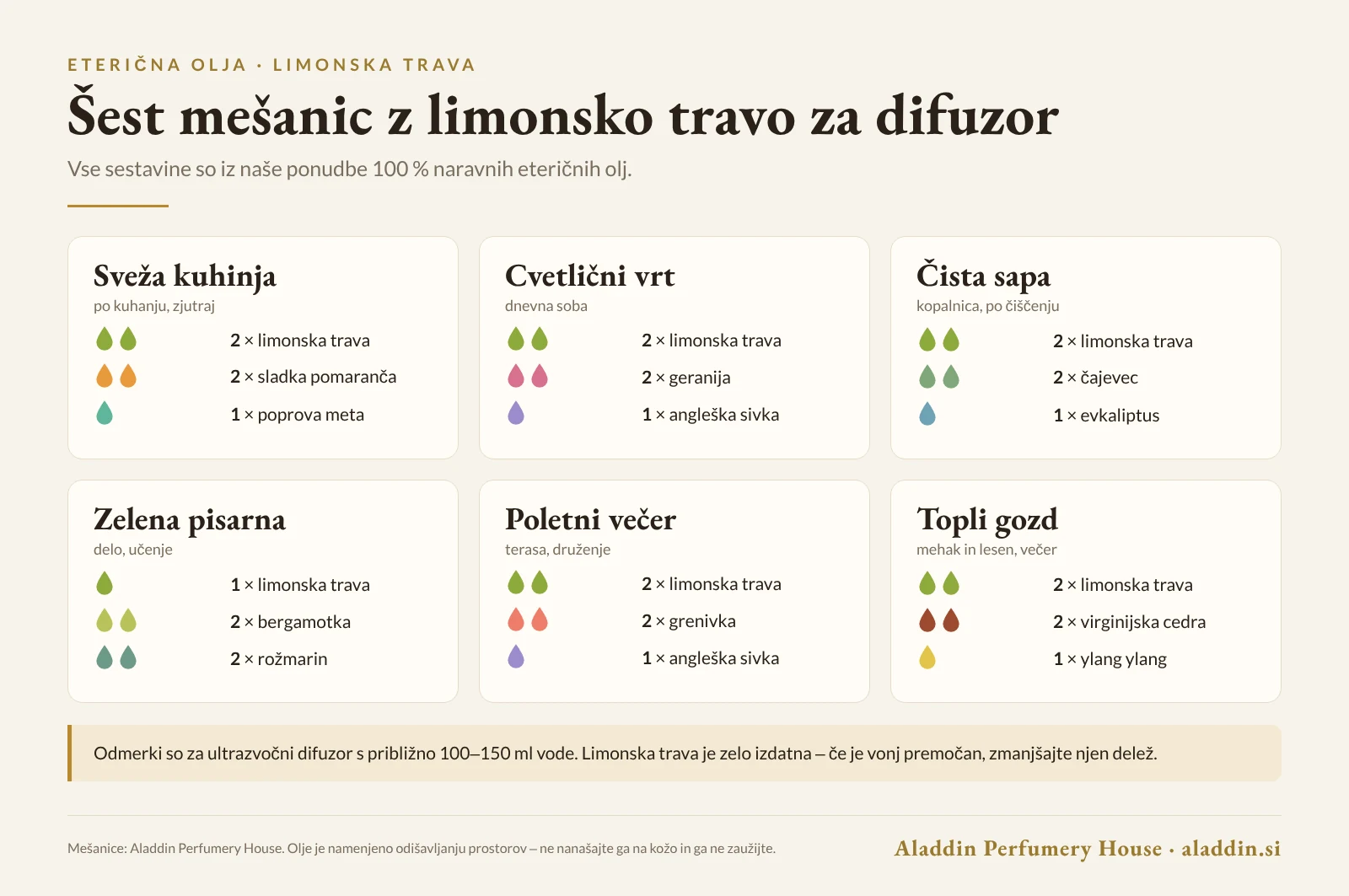
The following blends use only oils from our range; the amounts are for an ultrasonic diffuser with about 100–150 ml of water.
| Blend | Composition (drops) | When |
|---|---|---|
| Fresh kitchen | 2 lemongrass + 2 sweet orange + 1 peppermint | after cooking, in the morning |
| Flower garden | 2 lemongrass + 2 geranium + 1 English lavender | living room |
| Clean air | 2 lemongrass + 2 tea tree + 1 eucalyptus | bathroom, after cleaning |
| Green office | 1 lemongrass + 2 bergamot + 2 rosemary | work, study |
| Summer evening | 2 lemongrass + 2 grapefruit + 1 English lavender | terrace, socialising |
| Warm forest | 2 lemongrass + 2 Virginia cedarwood + 1 ylang-ylang | evening |
Tip: lemongrass quickly dominates, so use it in smaller proportions in blends with floral oils. With woody oils such as cedarwood it gains depth and staying power.
 LemongrassJuicy, grassy freshnessView product
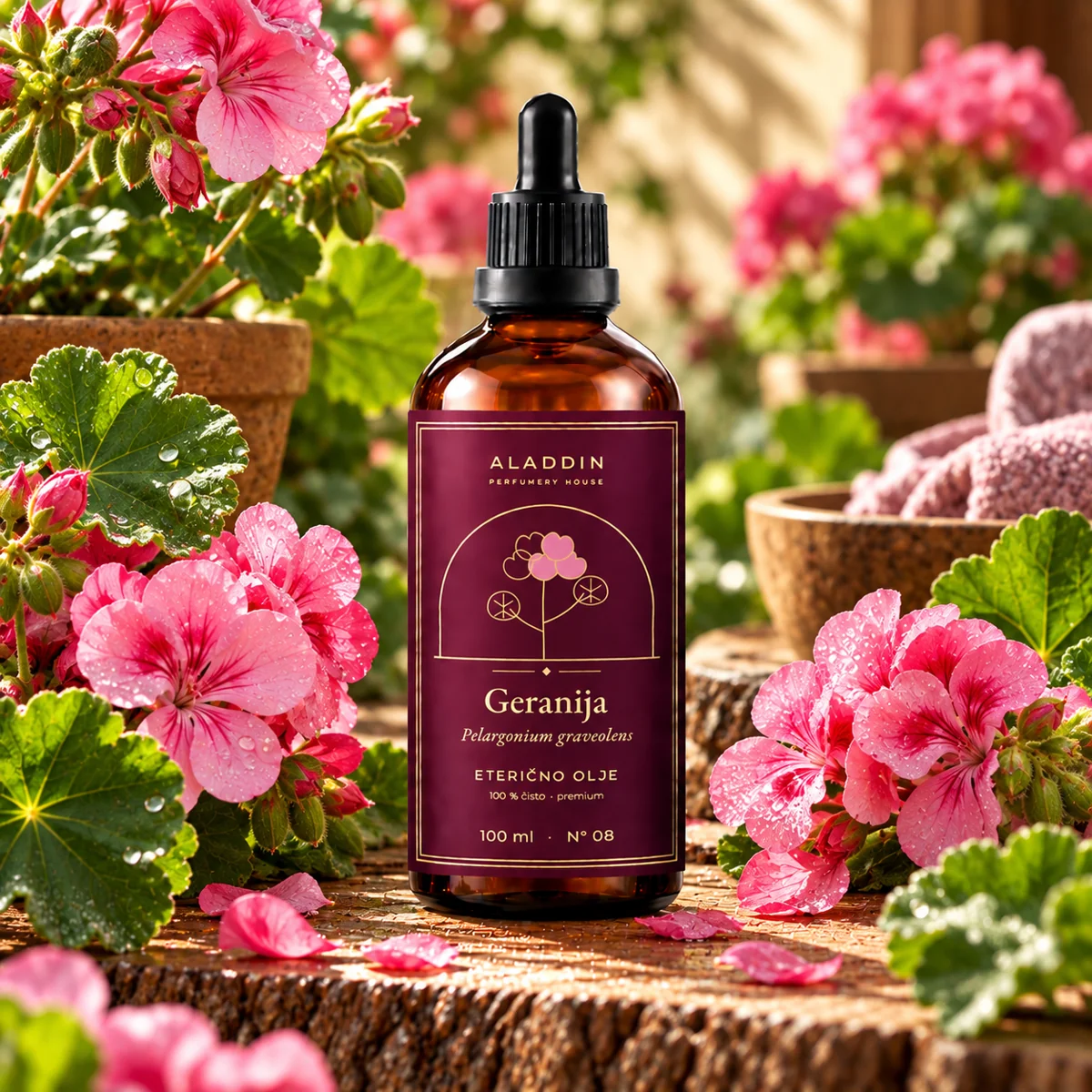 GeraniumThe loveliest floral pairView product
 Tea treeFor a clean, fresh homeView product
Safe use – a few rules to follow
- Do not apply the oil to the skin or take it internally. Our oil is neither a cosmetic product nor a spice, but a concentrate for scenting rooms.
- The oil can cause serious eye damage. If it gets into the eyes, rinse them carefully with water for several minutes, remove contact lenses and immediately call the poison centre or a doctor.
- On the skin it causes irritation and may cause an allergic reaction – citral is a known allergen. Wear gloves when working with the oil, for example when preparing a swarm lure.
- Always close the bottle tightly and store it in a cool, dark place out of the reach of children. It has a child-resistant cap.
- Pregnant and breastfeeding women and parents of very young children should discuss use with a doctor. Do not use the diffuser in a room where a baby is sleeping.
- Pets: cats are particularly sensitive to essential oils. While the diffuser is running, the animal should always be able to move to a scent-free room.
- The oil is toxic to aquatic life, so do not pour leftovers down the drain or into nature.
- Beekeepers: use the oil only as a lure in an empty bait hive, never in feed or in a hive with honey. Only authorised medicines may be used to treat bees.
- Aromatherapy does not replace medical treatment. If you have health problems, consult your doctor.
A safety data sheet is available for every oil, and we will email it to you on request. You can see the label with all warnings on the product page.
Frequently asked questions
Is lemongrass the same as citronella?
No. Both belong to the genus Cymbopogon, but they are different species with different oils. Lemongrass is dominated by citral, citronella by citronellal, geraniol and citronellol.
Why do beekeepers use lemongrass oil?
Because it contains a lot of citral, which is also a constituent of the Nasonov pheromone that bees use to mark their home and guide other bees. That is why the oil attracts swarms into empty bait hives.
How much oil do I put in a bait hive?
Just a few drops (2–5) on a cotton pad or stick, on the top bars of the frames or by the entrance. Too much oil repels bees. Refresh the lure every few weeks during the swarming season.
Can I treat bees with lemongrass oil?
No. The oil is not a medicine for bees. Only authorised veterinary medicines for bees may be used for Varroa control and disease treatment.
Can I use lemongrass oil for cooking?
No. Our oil is not intended for consumption. For cooking, use fresh or dried lemongrass.
How many drops do I put in the diffuser?
For an ultrasonic diffuser, 3–5 drops per 100 ml of water. Because the scent is very powerful, start with three.
Which oils pair best with lemongrass?
Sweet orange, grapefruit and bergamot, geranium and lavender, tea tree, eucalyptus and rosemary, and Virginia cedarwood.
Does it repel mosquitoes?
Only weakly and briefly. For reliable protection against mosquitoes, use an authorised repellent.
A grass that links the kitchen, the laboratory and the apiary
Few plants lead such a varied life as lemongrass. It flavours Thai soup and Brazilian tea, scented soaps and cleaners for decades, its citral was used to make the first synthetic vitamin A, and today beekeepers use it to lure swarms. All because of a single molecule – citral, which this grass contains more of than almost any other plant.
If you would like to get to know it, start simply: put two drops of lemongrass and two drops of sweet orangeinto the diffuser. You will find the whole range in the category Pure essential oils. In the previous parts of the series we introduced geranium, Virginia cedarwood and frankincense.
In the next part of the series we will introduce another oil from our range. If you have any questions, write to us or call – we are happy to advise you.
Sources
- PROSEA (Pl@ntUse): Cymbopogon flexuosus – origin, cultivation, citral, yield and uses
- Wikipedia: Cymbopogon – etymology and species
- Gernot Katzer’s Spice Pages: Lemon grass
- Salvatore Battaglia: Lemongrass – monograph (composition, safety)
- Melo E. C. et al. (2008): Evaluation of the chemical composition of Brazilian commercial Cymbopogon citratus samples – Molecules 13(8)
- Chemistry World: Citral – vitamin A, Nasonov pheromone
- American Bee Journal (April 2017): comparison of lemongrass oil and Nasonov pheromone in swarm traps
- The Apiarist: Bait hives
- Science Friday: Househunting for honey bees (T. Seeley)
- SARE project GS09-086: Alternative treatments for Nosema disease of honey bees in Tennessee
- Goes T. C. et al. (2015): Effect of lemongrass aroma on experimental anxiety in humans – J Altern Complement Med
- Kusuma I. Y. et al. (2024): Exploring the clinical applications of lemongrass essential oil: a scoping review – Pharmaceuticals 17(2)
- Silva C. B. et al. (2008): Antifungal activity of the lemongrass oil and citral against Candida spp. – Braz J Infect Dis


