
Blog
English lavender: the true lavender that smells of clean linen and feeds bees – history, production, properties and use

There are few scents that almost everyone recognises. Lavender is one of them. It smells of grandmother’s wardrobe with its linen sachets, of clean laundry, of a summer afternoon on Hvar or in Provence when the fields hum with bees. It is also one of the most researched aromatic plants – and one surrounded by the most half-truths.
In the fifth part of our essential oil series it is the turn of English lavender. After geranium, Virginia cedarwood, frankincense and lemongrass we turn to a plant everyone knows, but few can tell apart from its cousin lavandin. We look at what the plant is like, how it travelled through history, how oil is made from it, what it contains, what is really proven – and why bees love it so much.
Our English lavender essential oil is 100 % pure essential oil from the flowering tops of Lavandula angustifolia, obtained by steam distillation.

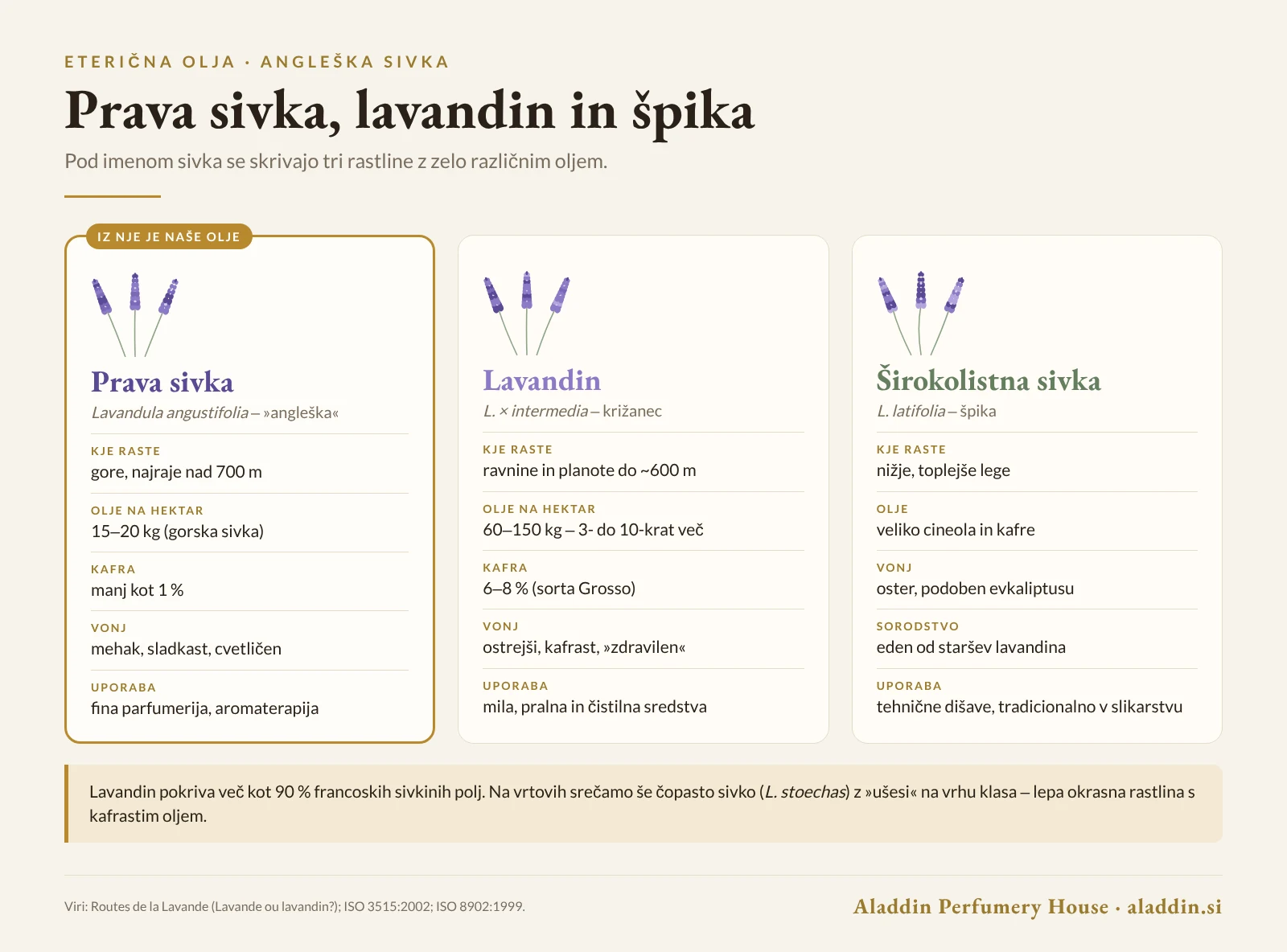
True lavender, lavandin and spike lavender
Lavender belongs to the mint family (Lamiaceae) – the same family as mint, rosemary, thyme and sage. The genus Lavandula has almost 40 species, native from the Canary Islands and the Mediterranean to India.
English or true lavender (Lavandula angustifolia, in older books also L. officinalis or L. vera) is an evergreen subshrub 30 to 60 centimetres tall. It has narrow, grey-green leaves and violet flowers in spikes on long bare stalks. It grows wild in the mountains of the western Mediterranean – in the Pyrenees, the French Alps and the Apennines, preferably above 700 metres on dry limestone slopes.
The name English does not say where the plant comes from but recalls an English tradition. In the 18th and 19th centuries lavender was grown in the fields around Mitcham south of London, and its oil was renowned as one of the finest in the world. So the name “English lavender” stuck to the whole species L. angustifolia, wherever it grows.
Under the name lavender, however, there are three plants with different oils:
- True (English) lavender (L. angustifolia) – a mountain species with a soft, sweetish, floral oil containing very little camphor. The yield is small, but the oil is the most prized. Our oil comes from this species.
- Broad-leaved lavender or spike lavender (L. latifolia) – grows lower down, in warmer places. Its oil is sharp, camphoraceous and similar to eucalyptus.
- Lavandin (L. × intermedia) – a natural hybrid of true and spike lavender. It is larger, more vigorous and gives three to ten times more oil per hectare, so it covers more than 90 % of French lavender fields. Its oil is cheaper, sharper and camphoraceous – used mainly for soaps, detergents and cleaners.
In gardens and on balconies you will also often see French or Spanish lavender (L. stoechas) with its typical “ears” on top of the spike. It is a beautiful ornamental plant, but its oil is camphoraceous and has little in common with true lavender.
Lavender in your garden
True lavender is one of the few Mediterranean aromatic plants that overwinter outdoors in Central Europe without problems. It needs sun, free-draining, preferably limy soil and “dry feet” – waterlogging quickly kills it. After flowering it is cut back, but never into the old woody part, which does not resprout. Lavender is also an excellent bee plant; more on this in the chapter on bees.
History: from monastery gardens to the world’s largest plantations
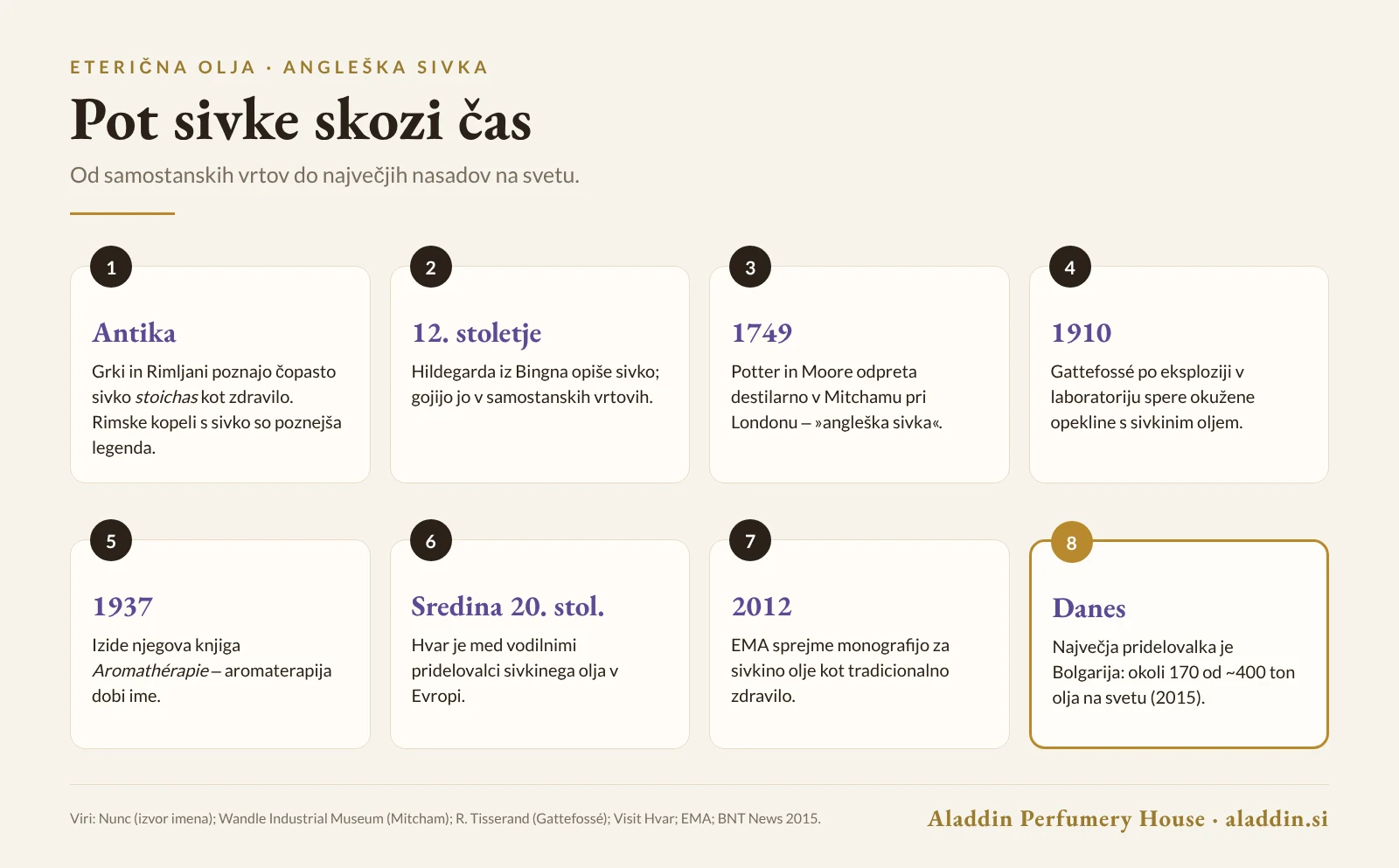
The ancient Greeks and Romans mainly knew French lavender, which they called stoichas after the Stoechades islands (today’s Îles d’Hyères) near Marseille. The Greek physician Dioscorides described it as a remedy. The popular story that the Romans scented their baths with lavender and that the name comes from the Latin lavare (to wash) finds no support in ancient sources – the word lavendula only appears in the Middle Ages, and linguists still debate its origin.
In the Middle Ages lavender was grown in monastery gardens. The abbess Hildegard of Bingen described it in the 12th century in her work on plants and remedies. In the Renaissance and later, physicians recommended it for headaches and “weak nerves”, lavender water became one of the most popular scents in Europe, and linen sachets of dried flowers found their way into wardrobes and chests.
In 1749 Ephraim Potter and William Moore opened a lavender oil distillery in Mitcham. In the 19th century the fields around Mitcham were a “sea of blue”, and at harvest time workers toiled up to 14 hours a day. English lavender oil was the basis of the perfumes and lavender waters that all of Europe bought.
In Provence lavender was gathered wild in the mountains for centuries; in the 20th century people began to grow it in fields – first true lavender, later more and more lavandin. The Croatian island of Hvar also started growing lavender in the early 20th century and by the middle of the century was among Europe’s leading producers of lavender oil.
In 1910 the French chemist René-Maurice Gattefossé suffered severe burns to his hands in a laboratory explosion, and they became infected. By his own account he rinsed the wounds with lavender oil and his condition improved. In 1937 he published the book Aromathérapie and gave aromatherapy its name. The story was later considerably embellished – more on that under the myths.
Today the world’s largest producer of lavender oil is Bulgaria, which overtook France around 2014. According to 2015 figures it produced around 170 of the roughly 400 tonnes of oil produced worldwide. In 2012 the European Medicines Agency (EMA) adopted a monograph on lavender oil as a traditional herbal medicine.
From harvest to the bottle: how the oil is made
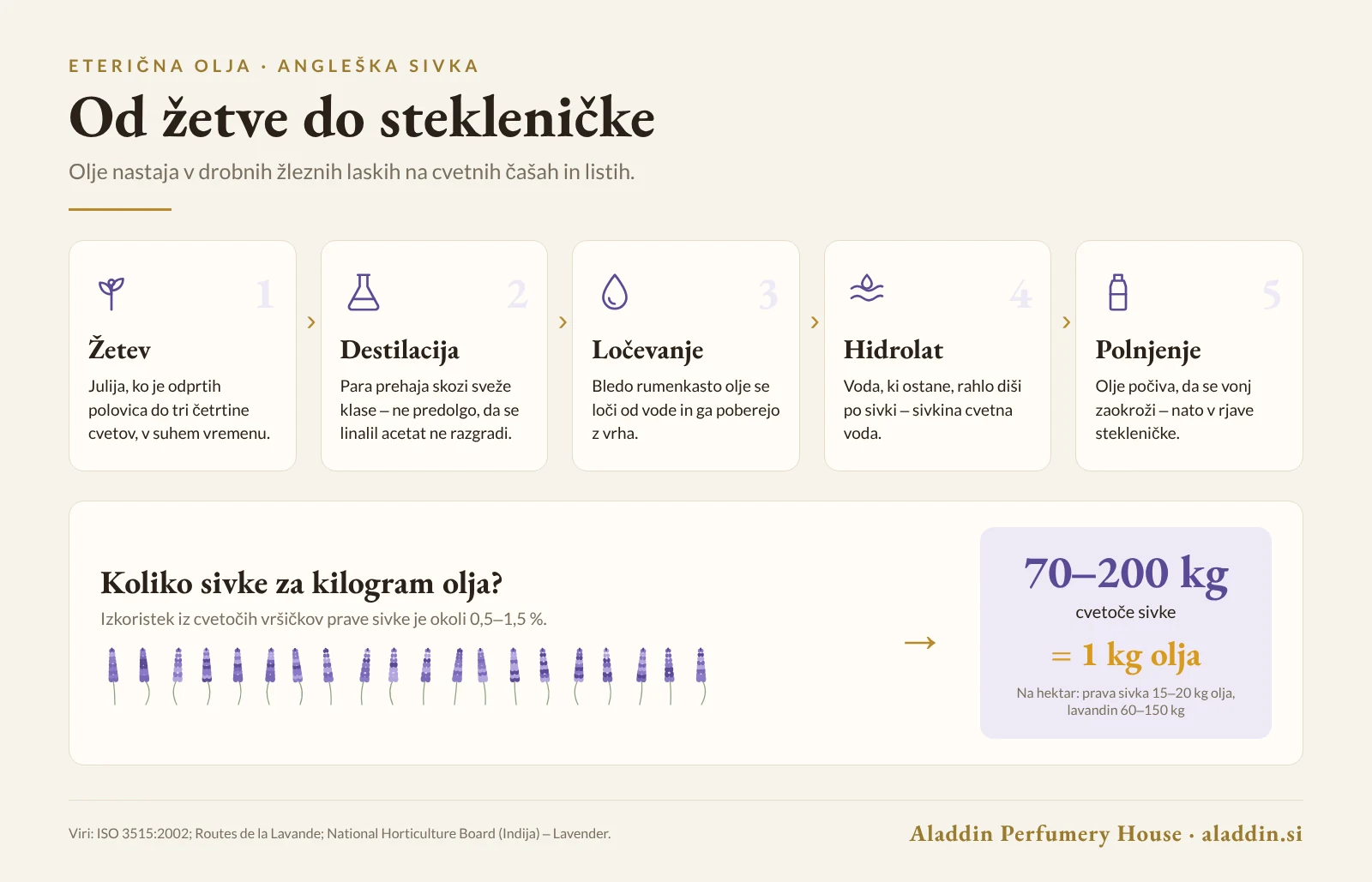
The oil forms in tiny glandular hairs on the flower calyces and leaves. There is most of it when about half to three quarters of the flowers are open, so lavender is harvested in July in dry, sunny weather.
- Harvest. The flowering spikes are cut together with their stalks – on large fields with harvesters, in the mountains still also by hand with a sickle.
- Steam distillation. The fresh flowering tops are packed into a still through which steam passes, carrying away the volatile substances. Distillation must not be too long or too hot, otherwise the precious linalyl acetate breaks down and the oil loses its softness.
- Separation. In the condenser the steam turns to liquid, and the pale yellowish oil separates from the water and is skimmed off the top.
- Floral water. The remaining water smells faintly of lavender – this is lavender hydrosol.
- Maturing and bottling. The oil rests for a while so the scent rounds out, then we fill it into brown bottles that protect it from light.
The yield is relatively small: the flowering tops of true lavender give about 0.5 to 1.5 % oil, so one kilogram of oil requires distilling about 70 to 200 kilograms of fresh lavender. One hectare of wild or mountain true lavender yields only 15 to 20 kg of oil, lavandin 60 to 150 kg – which is why true lavender oil is more expensive.
The dried straw left after distillation does not go to waste: it is used as mulch, compost or fuel. We have described how essential oils are made in more detail in the article Essential oils: from plant to bottle.
What is in a drop: the composition of the oil
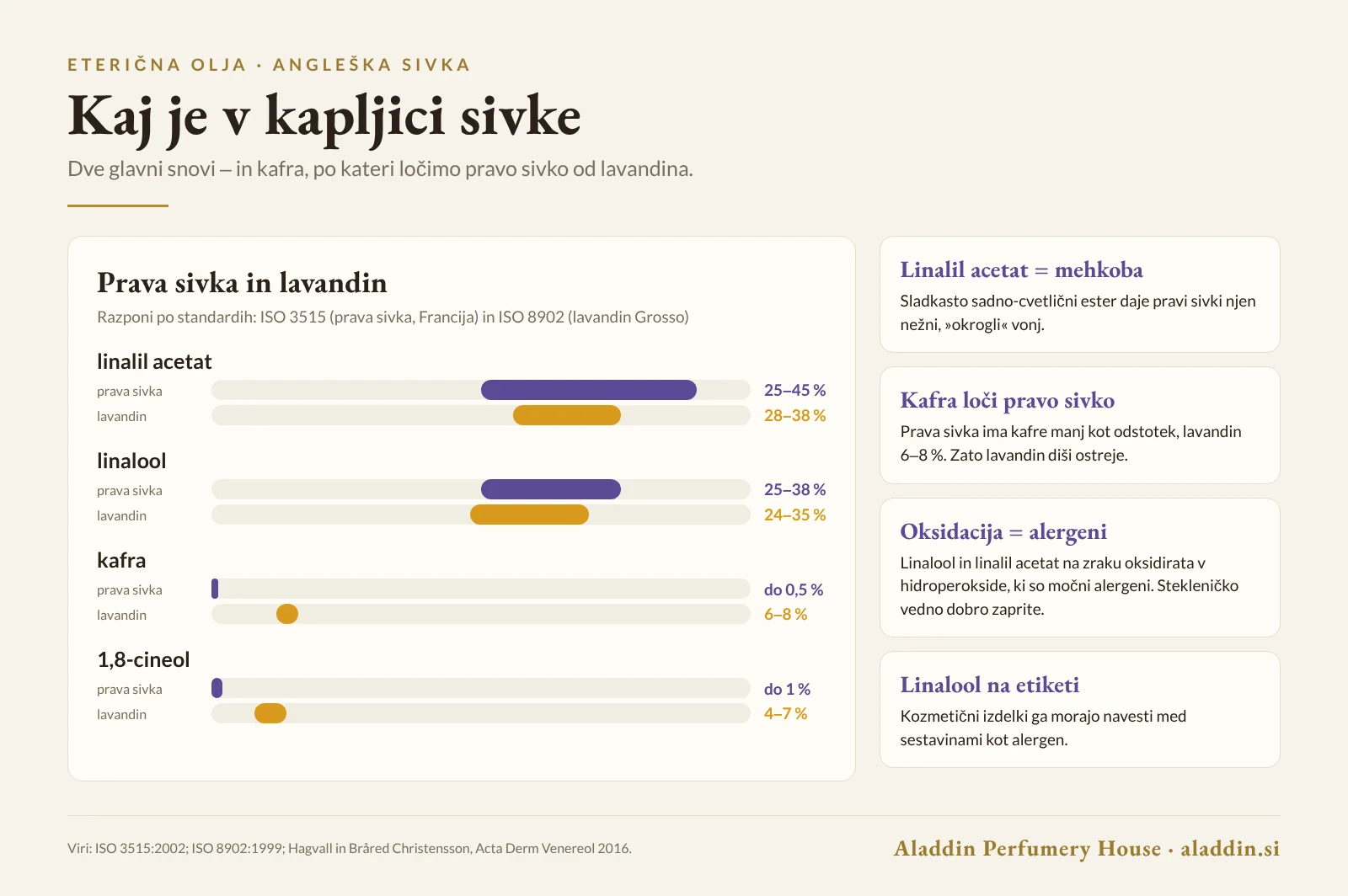
The quality of lavender oil is defined by the international standard ISO 3515. According to it, true lavender oil consists mainly of two substances:
- linalyl acetate – a sweetish fruity-floral ester that gives true lavender its softness, usually 25 to 45 %,
- linalool – a fresh, floral alcohol also found in coriander and bergamot, usually 25 to 38 %,
- cis- and trans-beta-ocimene, terpinen-4-ol and lavandulyl acetate – green, herbaceous nuances, a few per cent each,
- camphor and 1,8-cineole – there is little of them in true lavender: camphor usually under one per cent, cineole at most two or three per cent.
It is precisely in camphor and cineole that true lavender differs most from lavandin. Lavandin Grosso, the most widespread variety, contains according to ISO 8902 6 to 8 % camphor and 4 to 7 % cineole – which is why it smells sharper and “more medicinal”.
Linalool and linalyl acetate have another important property: they oxidisein air. This produces hydroperoxides, which are strong allergens. Fresh linalool rarely irritates the skin, but oxidised linalool is one of the more common causes of fragrance allergy. That is why it is important to always close the bottle well, store it cool and dark, and not to use old oil with a sharp, sourish smell. Cosmetic products must list linalool among their ingredients as an allergen.
How English lavender oil smells
The scent of true lavender is floral, soft and clean, with a herbaceous edge and a barely noticeable fruity, almost honeyed hint. Compared with lavandin it is sweeter, gentler and lacks the camphoraceous sharpness familiar from cheaper lavender products. A good true lavender oil smells “round” – nothing sticks out.
In perfumery lavender is one of the most important raw materials. Since the late 19th century it has been the basis of the fougère fragrance family (French for “fern”) – a combination of lavender, coumarin and oakmoss from which a large part of classic men’s fragrances derives. It is also a classic of the clean-laundry scent. In blends it pairs beautifully with clary sage, bergamot and other citrus oils, geranium, Virginia cedarwood and frankincense.
Lavender is the scent of clean laundry drying in the summer sun – simple, homely and calming.
Lavender and bees
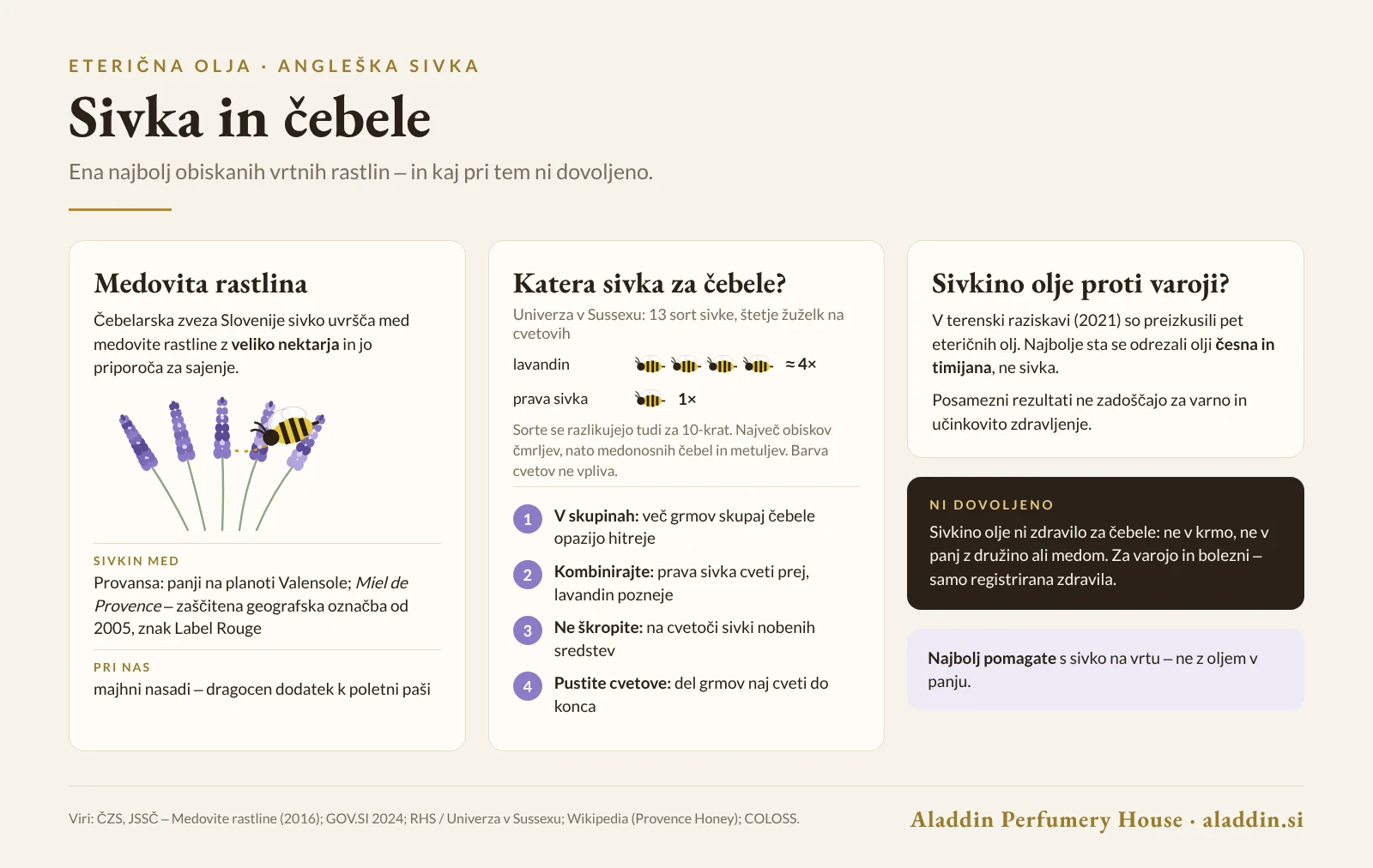
Anyone with a lavender bush in the garden knows it is never alone in summer. Lavender is among the most visited garden plants. The Slovenian Beekeepers’ Association lists it among bee plants rich in nectar and recommends it for planting on the day of bee-friendly planting – together with purple coneflower and autumn asters.
Lavender honey
Where plantations are large enough, beekeepers produce single-flower lavender honey. The best known comes from Provence: in summer beekeepers move their hives to the Valensole plateau and around Mont Ventoux, where lavender and lavandin bloom. Miel de Provence has been protected by a European geographical indication since 2005, and lavender and lavandin honey also carry the French Label Rouge quality mark. In Central Europe lavender plantings are small, so lavender is mainly a valuable addition to summer forage – at a time when fewer plants are flowering in nature.
Which lavender is best for bees?
At the University of Sussex, the Laboratory of Apiculture and Social Insects planted 13 common lavender varieties of three species and counted the insects on the flowers. The varieties differed in attractiveness by up to ten times. On average lavandin attracted about four times more pollinators than true lavender, and flower colour had no effect. Bumblebees were the most numerous, but lavender is also visited by honey bees, butterflies and the hummingbird hawk-moth.
What this means for the garden and the apiary:
- Plant in groups. Bees notice several bushes together faster than a single plant.
- Combine. True lavender flowers slightly earlier, lavandin later – together they extend forage through the summer.
- Do not spray during flowering. Do not use plant protection products on flowering lavender.
- Leave some flowers for the bees. For dried lavender the spikes are cut when the first flowers open – let some bushes flower to the end.
Lavender oil in the hive?
Online you will find tips on lavender oil against Varroa. In a field study (2021) five essential oils were tested, including lavender – garlic and thyme oils performed best, not lavender. Laboratory and isolated field results are not enough for safe and effective treatment.
Where else lavender comes in handy
- In the wardrobe. Linen sachets of dried flowers are an old household custom. They give laundry a pleasant scent, but against moths they act at most as a deterrent – they do not kill larvae that are already eating wool. Clean clothes, airing and regular checks of the wardrobe help more than the scent.
- In the kitchen – dried flowers. A pinch of true lavender flowers flavours pastries, ice cream, lemonade or honey. Lavender is also part of modern herbes de Provence blends. Use a little – too much lavender tastes of soap. The essential oil is not for cooking.
- In perfumery and laundry. Lavender is the basis of fougère fragrances, lavender water and the clean scent we know from detergents and soaps, such as our lavender soap.
- In the waiting room. In a Greek dental practice, 340 patients were divided into two groups: those who waited in a room scented with lavender reported less anxiety before treatment (2010). The effect was immediate and short-lived – a calming background, not a treatment.
- In the bedroom. Lavender is a classic of the evening ritual: a few drops in the diffuser half an hour before bed, then switch the diffuser off and air the room.
Properties: what is proven, what is researched and what is folk tradition
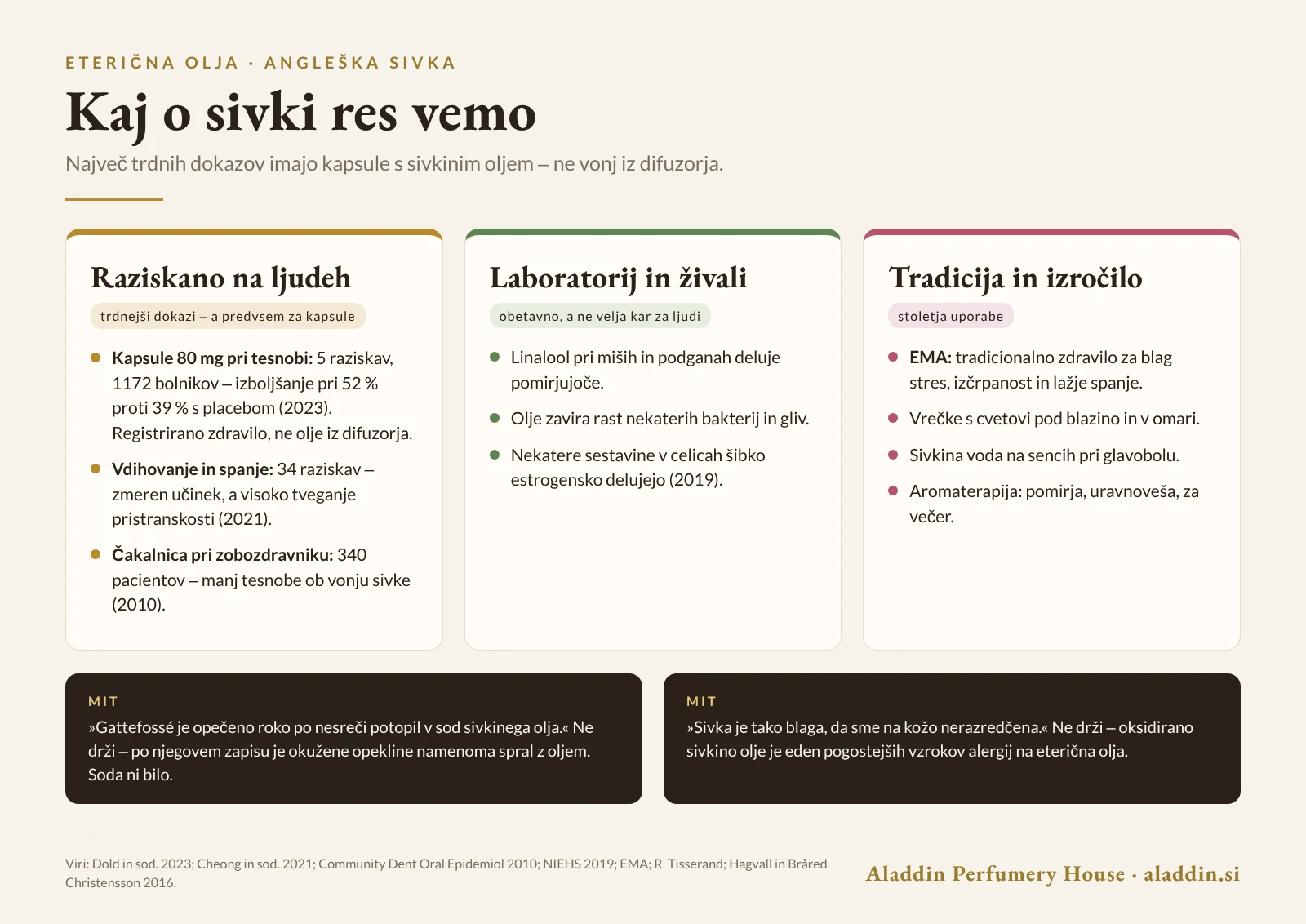
Among essential oils, lavender is better researched than most. But note: the strongest evidence is for special medicines with lavender oil in capsules, not for the scent from a diffuser. These must be kept apart.
Researched in humans
- Capsules for anxiety. A medicine with standardised lavender oil in 80 mg capsules has been tested in several clinical trials. An analysis of five trials with 1,172 patients (2023) showed that anxiety decreased more than with placebo – 52 % of patients on capsules and 39 % on placebo improved. All trials were funded by the manufacturer. This is an authorised medicine, not essential oil from a diffuser – never swallow our oil.
- Traditional use. The EMA recognises lavender oil as a traditional herbal medicine for relieving mild stress and exhaustion and to aid sleep – taken orally and as a bath additive. Traditional use means long-standing safe use, not clinically proven efficacy.
- Inhalation and sleep. A review of 34 studies of inhalation aromatherapy (2021), in which lavender was used most often, showed a moderate effect on sleep quality, stress and anxiety. However, the authors found a high risk of bias in most studies (often there was no blinding), so the results are less reliable than they appear.
- Scent in the waiting room. Less anxiety in patients who waited for the dentist in a room scented with lavender (340 patients, 2010).
In the laboratory
- Calming in animals. Linalool had a calming effect in mice and rats, which fits the tradition of lavender for sleep.
- Antimicrobial. In the laboratory lavender oil inhibits the growth of some bacteria and fungi. This does not mean the oil cures infections.
- Hormonal activity in cells. In a 2019 study some constituents of lavender and tea tree oil showed weak oestrogenic activity in human cells. More on this in the safety chapter.
Folk tradition and aromatherapy
For centuries lavender has been a “herb for the nerves”: for easier sleep, against headaches, to calm down after a tiring day. Sachets of flowers were placed under pillows and in wardrobes, and ladies rubbed lavender water on their temples. Aromatherapists describe the oil as calming and balancing, suitable for the evening, relaxation and the bedroom. All this is based on experience and can be a pleasant part of an evening ritual – but it is no substitute for treating insomnia or anxiety.
Two myths you can safely forget
- “Gattefossé accidentally plunged his burnt hand into a vat of lavender oil, and it healed miraculously.” Not true. According to his own account it was a laboratory explosion, the burns became infected, and he deliberately rinsed the wounds with lavender oil. There was no vat. Burns should be cooled under cold running water and shown to a doctor – essential oil does not belong on them.
- “Lavender is so gentle that you can apply it neat to the skin.” Not true. Among essential oils, oxidised lavender oil is one of the more common causes of contact allergy – in a Swedish study, 2.8 % of tested eczema patients reacted to it. Our oil is intended for scenting rooms, not for the skin.
How we use lavender at home
Our oil is intended for scenting rooms. It is soft and unobtrusive – ideal for the bedroom, evening relaxation, the living room and the bathroom.
- Ultrasonic diffuser: 3–5 drops per 100 ml of water. In the bedroom, switch the diffuser on half an hour before bed and switch it off when you go to sleep.
- Waterless nebuliser: pour the oil into the device’s bottle and screw it on.
- Scent stones, wooden beads or ceramics: 2–3 drops, repeat as needed.
For the living room the Urban diffuseris a lovely choice, for the bedroom the Himalayan salt night light. Air the room occasionally during use.
Six lavender blends for the diffuser
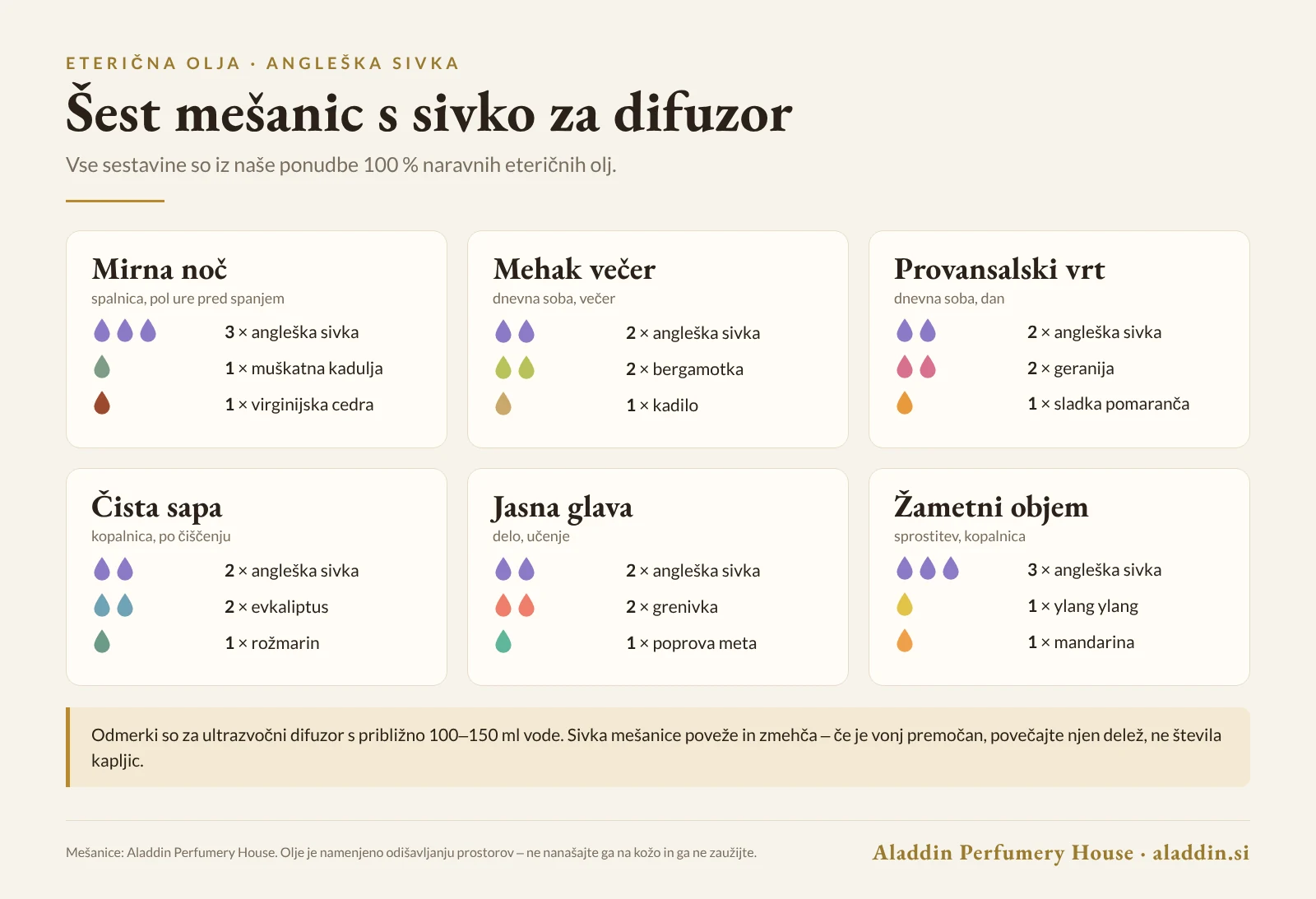
The following blends use only oils from our range; the amounts are for an ultrasonic diffuser with about 100–150 ml of water.
| Blend | Composition (drops) | When |
|---|---|---|
| Quiet night | 3 English lavender + 1 clary sage + 1 Virginia cedarwood | bedroom, half an hour before bed |
| Soft evening | 2 English lavender + 2 bergamot + 1 frankincense | living room, evening |
| Provençal garden | 2 English lavender + 2 geranium + 1 sweet orange | living room, daytime |
| Clean air | 2 English lavender + 2 eucalyptus + 1 rosemary | bathroom, after cleaning |
| Clear head | 2 English lavender + 2 grapefruit + 1 peppermint | work, study |
| Velvet embrace | 3 English lavender + 1 ylang-ylang + 1 mandarin | relaxation, bathroom |
Tip: lavender is an excellent “binding” note – it adds softness to blends that are too sharp or too sweet and ties them together. If a blend is too strong for you, increase the proportion of lavender, not the number of drops.
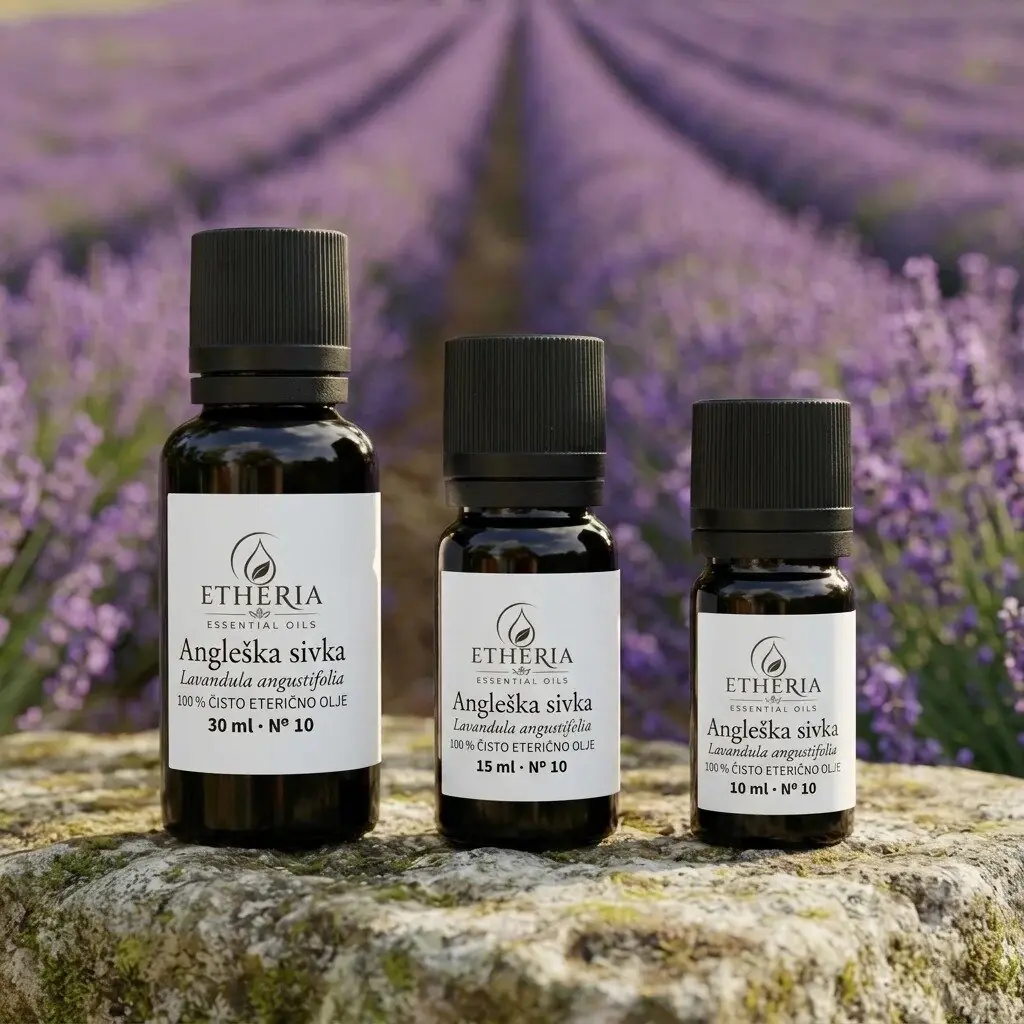 English lavenderSoft, clean, floralView product
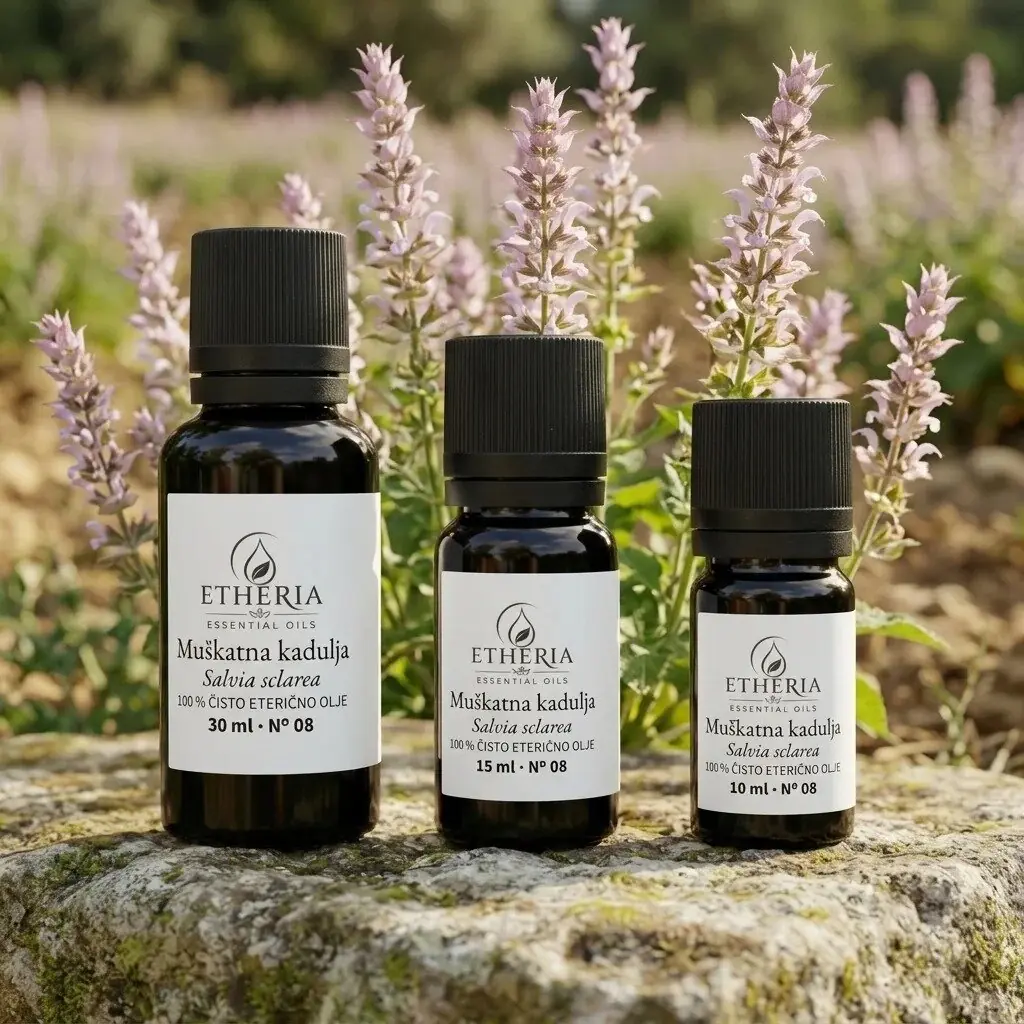 Clary sageThe perfect pair for the eveningView product
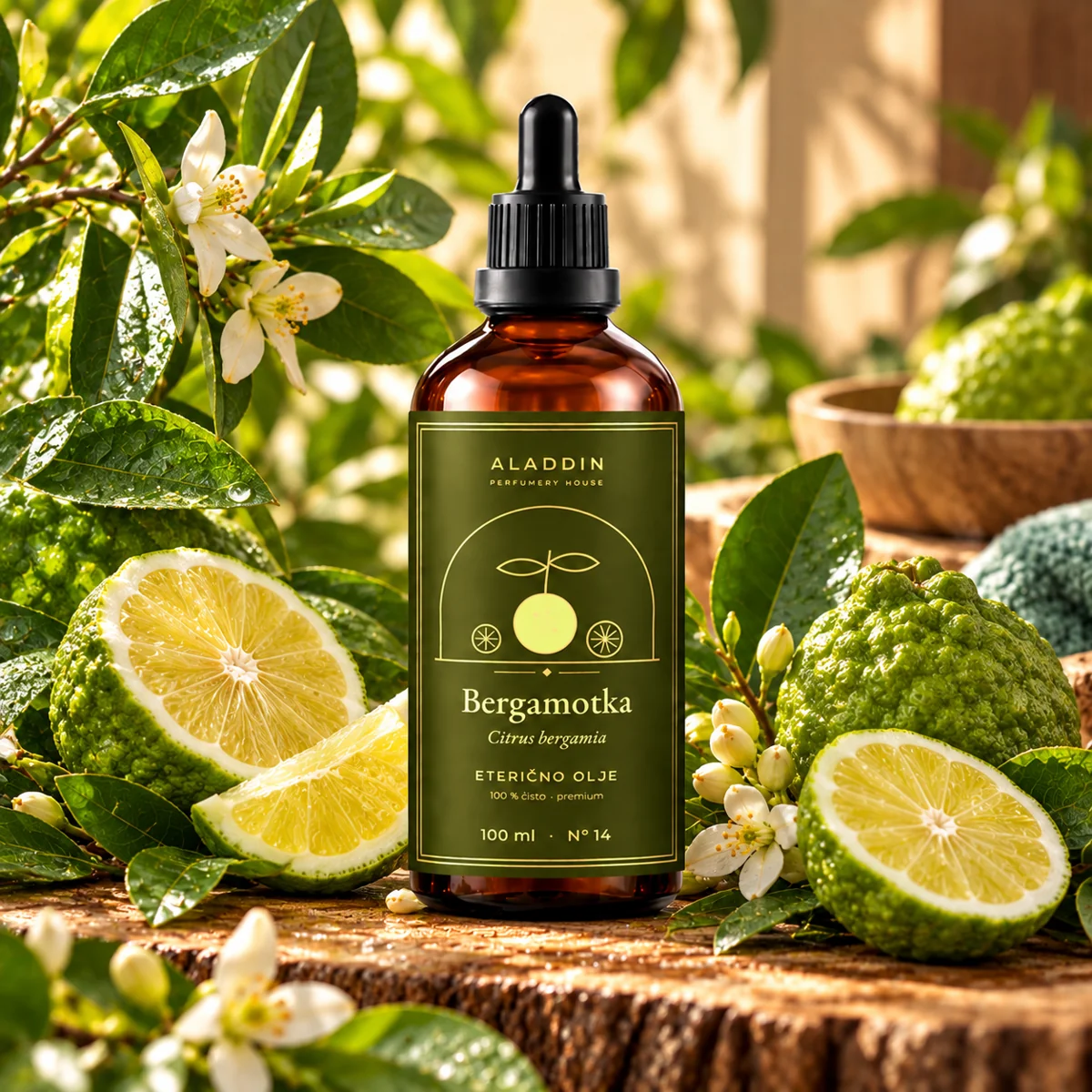 BergamotA bright citrus companionView product
Safe use – a few rules to follow
- Do not apply the oil to the skin or take it internally. Our oil is not a cosmetic, a medicine or a spice, but a concentrate for scenting rooms. The lavender oil capsules from the studies are a specially manufactured, authorised medicine.
- Protect your eyes. If oil gets into the eyes, rinse them carefully with water for several minutes and remove contact lenses. If irritation persists, seek medical advice.
- Oxidised oil is an allergen. Always close the bottle tightly and store it in a cool, dark place. Do not use oil whose scent has changed and smells sharp or sourish.
- Children and babies: in a child’s room use the diffuser only occasionally and briefly, when the child is not in the room, and then air it. Do not use the diffuser in a room where a baby is sleeping. Pregnant and breastfeeding women should discuss use with a doctor.
- Lavender and hormones. In a few boys before puberty, breast enlargement has been described with regular use of lavender cosmetics on the skin (colognes, shampoos, soaps); it subsided after use stopped. A causal link has not been proven and the authors describe the phenomenon as very rare, but it is one more reason not to apply essential oil to children’s skin.
- Pets: cats are particularly sensitive to essential oils. While the diffuser is running, the animal should always be able to move to a scent-free room.
- The oil is harmful to aquatic life, so do not pour leftovers down the drain or into nature.
- Beekeepers: do not use lavender oil in feed or in a hive with a colony or honey. Only authorised medicines may be used to treat bees.
- Aromatherapy does not replace medical treatment. If you have problems with sleep or anxiety, consult your doctor.
A safety data sheet is available for every oil, and we will email it to you on request. You can also see all warnings on the product page.
Frequently asked questions
What is the difference between English lavender and lavandin?
English or true lavender (Lavandula angustifolia) is a mountain species with a soft, floral oil and only traces of camphor. Lavandin (L. × intermedia) is a hybrid of true and spike lavender that gives much more oil, but it contains 6–8 % camphor and more cineole, so it smells sharper.
Why is it called English?
The name recalls the English tradition of growing lavender at Mitcham near London in the 18th and 19th centuries, when the oil from there was considered one of the finest. Today “English lavender” is the common name of the species Lavandula angustifolia.
Does lavender help with sleep?
The EMA recognises lavender oil as a traditional medicine to aid sleep, and inhalation studies show a moderate effect, but most are of lower quality. Lavender in a diffuser can be a pleasant part of an evening ritual, but it does not replace treatment for insomnia.
Can I take lavender oil like the capsules from the studies?
No. The capsules from the studies are an authorised medicine with specially processed, standardised oil in a precise dose. Our oil is intended only for scenting rooms.
Is lavender good for bees?
Yes, lavender is a bee plant rich in nectar. Lavandin is even more popular with pollinators. It is best to plant several bushes together and not to spray them while they are flowering.
Can I use lavender oil in the hive against Varroa?
No. Lavender oil is not a medicine for bees. Only authorised veterinary medicines for bees may be used for Varroa control and disease treatment.
How many drops do I put in the diffuser?
For an ultrasonic diffuser, 3–5 drops per 100 ml of water. In the bedroom, switch the diffuser on half an hour before bed and off when you go to sleep.
Does lavender repel moths?
At most weakly, as a deterrent. Dried flowers scent the wardrobe nicely, but they do not kill larvae that are already eating wool. Clean clothes, airing and regular checks of the wardrobe help most.
A plant that links the wardrobe, perfumery and the apiary
Few plants are as familiar as lavender. From the mountain slopes of the Mediterranean it came into monastery gardens, from Mitcham into the wardrobes of all Europe, from Bulgarian and Provençal fields into perfumes and detergents, and with Gattefossé it gave aromatherapy its name. It is one of the few aromatic plants whose effects have been seriously studied in clinical trials – and at the same time one of the favourite plants of bees and bumblebees in our gardens.
If you would like to get to know it, start simply: in the evening put three drops of English lavender and one drop of clary sageinto the diffuser. You will find the whole range in the category Pure essential oils. In the previous parts of the series we introduced geranium, Virginia cedarwood, frankincense and lemongrass.
In the next part of the series we will introduce another oil from our range. If you have any questions, write to us or call – we are happy to advise you.
Sources
- ISO 3515:2002 Oil of lavender (Lavandula angustifolia Mill.) – standard sample (iTeh)
- ISO 8902:1999 Oil of lavandin Grosso – standard sample (iTeh)
- Routes de la Lavande: Lavande ou lavandin?
- National Horticulture Board (India): Lavender – cultivation and oil yield
- Nunc: In antiquity, lavender didn’t cleanse – it cured (origin of the name)
- Wandle Industrial Museum: Mitcham lavender
- Robert Tisserand: Gattefossé’s burn
- Visit Hvar: Lavender on Hvar Island
- BNT News (2015): Bulgaria is again the world’s biggest producer of lavender oil
- EMA: Lavandulae aetheroleum – herbal medicinal product
- Dold M. et al. (2023): Efficacy of Silexan in patients with anxiety disorders: a meta-analysis – Eur Arch Psychiatry Clin Neurosci
- Cheong M. J. et al. (2021): Aroma inhalation therapy on sleep problems – systematic review and meta-analysis, Medicine
- DrBicuspid: Lavender scent can lower anxiety in dental patients (Community Dent Oral Epidemiol 2010)
- Hagvall L., Bråred Christensson J. (2016): Contact allergy to oxidized lavender oil – Acta Derm Venereol 96(5)
- NIEHS Environmental Factor (2019): Lavender and tea tree oils – endocrine activity
- Slovenian Beekeepers’ Association (2016): Medovite rastline (bee plants)
- GOV.SI (2024): Planting bee-friendly plants for bees and other pollinators
- RHS: Best lavenders for bees (University of Sussex research)
- Wikipedia: Provence Honey (IGP, Label Rouge)
- COLOSS: Controlling varroa mites using some essential oils and amitraz under colony conditions


