

Blog
Virginia cedarwood: the tree of pencils, chests and calm – history, extraction and properties of the essential oil

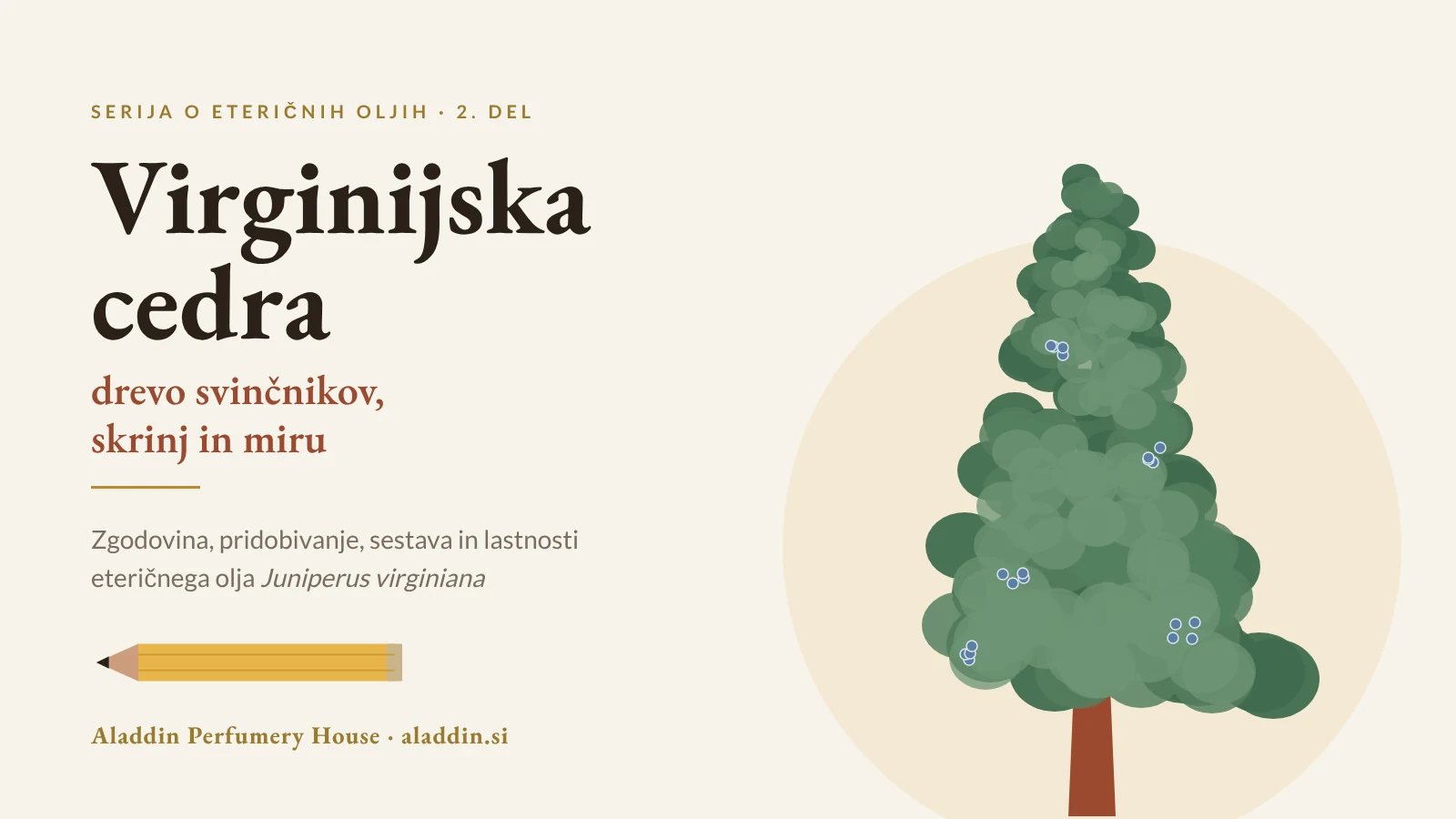
You open an old chest in the attic or sharpen a pencil with a kitchen knife – and for a moment there’s a dry, warm, slightly sweet scent. Almost everyone knows this smell, but few know its name. It’s the scent of Virginia cedarwood – the tree once used to make the world’s best pencils, hope chests and moth-repelling wardrobe linings.
In the second part of our essential oil series, it’s the turn of Virginia cedarwood. After geranium, which is actually a pelargonium, we’ve again come across a plant with a “borrowed” name: Virginia cedar isn’t a cedar at all. We’ll look at what it really is, why the native peoples of North America considered it a sacred tree, how pencil factories bought old fences from farmers, how oil is made from sawdust and what has been scientifically studied about it.
Our Virginia cedarwood essential oil is a 100% natural oil from the tree Juniperus virginiana from the USA, obtained by steam distillation of the wood. We fill it into brown 15 and 30 ml bottles.

A cedar that is really a juniper
True cedars (genus Cedrus) are mighty conifers of the pine family. They grow in the mountains of the Mediterranean and the Himalayas – Lebanon, Atlas, Cyprus and Himalayan cedar. They don’t grow naturally anywhere in North America.
When European settlers in America came across a tree with fragrant, reddish wood that didn’t rot, they named it after the wood they knew from home: cedar. Botanically, however, Juniperus virginiana is a juniper of the cypress family – a close relative of our common juniper (Juniperus communis), whose berries are used to make juniper brandy and gin. In botanical literature it is therefore called Virginian juniper, but in everyday language and perfumery the name Virginia cedar has stuck. In English it is also called eastern red cedar, aromatic cedar or simply pencil cedar.
The confusion doesn’t end there. On the market you’ll find several “cedarwood” oils that have little in common:
- Virginia cedarwood (Juniperus virginiana, USA) – a dry, soft pencil scent. Many perfumers consider it the finest cedarwood oil.
- Texas cedarwood (Juniperus ashei, Texas) – also a juniper, with a stronger, smokier and coarser scent.
- Atlas and Himalayan cedarwood (Cedrus atlantica, Cedrus deodara) – true cedars from Morocco and India. These oils are warmer, sweetish, slightly balsamic and completely different in composition.
- Chinese cedarwood (Cupressus funebris) – actually a cypress, the cheapest “cedarwood” oil.

A tree that survives almost anything
Virginia cedar is native to eastern North America – from Nova Scotia and Ontario in the north to Florida and eastern Texas in the south. It is a slow-growing evergreen tree with a dense, conical crown, usually 5 to 20 metres tall, occasionally up to 30. It can live for 300 years, and on inaccessible rocky cliffs in the Ozark Mountains grow twisted, gnarled trees more than a thousand years old.
Young plants and shoots have sharp, needle-like leaves, while mature trees have tiny, scale-like leaves that overlap tightly. In winter the olive-green crown turns bronze. The bark is reddish brown and peels in long, thin strips.
The trees are dioecious: male and female cones grow on separate trees. The female cones ripen into small, blue “berries” with a whitish waxy bloom that birds love. One of them, the cedar waxwing, is even named after them. Seeds that pass through a bird’s gut actually germinate better – which is how cedar spreads across abandoned fields and pastures.
Most prized of all, though, is the wood. The heartwood is reddish purple, darkening to reddish brown over time, while the sapwood is almost white. The wood is light, soft, easy to work, strongly scented and very resistant to rot – which is why for centuries it was used for fences, posts, shingles, chests and pencils.
Cedar is extremely adaptable. It tolerates drought, poor soil and cold, but not fire – young trees burn and mature ones don’t resprout after a fire. As long as the prairies burned regularly, it grew mainly on rocky cliffs. When people began putting out fires, it spread across the grasslands of the central USA. In Kansas and Oklahoma it is now considered invasive: on overgrown pastures the number of trees rose from about 8 to 180 per acre in nine years.
History: from sacred tree to pencil
For the native peoples of eastern North America, cedar was a “medicine tree”. The wood was burned mainly during ceremonies, as the smoke was believed to drive away bad influences. Twigs were boiled and poured over hot stones, and the steam was inhaled for rheumatic pain. The inner bark was woven into cords, bags and mats and used to make a red dye, and the branches were used for bedding.
Europeans quickly came to love the tree. It has been grown in European gardens since at least 1664. Its real fame came with the pencil. The wood is straight-grained, soft and doesn’t splinter when sharpened, so in the 19th century it became the best pencil wood. The German manufacturer Faber even planted thousands of Virginia cedars in Franconia to test whether the wood could be grown at home – but most of the plantations did not survive.
At the beginning of the 20th century cedar began to run out. In 1916 the Musgrave company was founded in Shelbyville, Tennessee, and it obtained pencil wood in an original way: it bought old, weathered cedar fences from farmers and put up new wire fences for them in return. The old posts were already dry and straight – ideal for pencils exported to Europe. By the end of the 1920s cedar had run out and manufacturers switched to California incense cedar (Calocedrus decurrens), which is still used for pencils today. Only in 2019, almost a hundred years later, did Musgrave once again make a pencil from Tennessee red cedar.
The second big story is cedar chests and wardrobes. American brides kept their trousseaus in cedar chests for centuries, and cedar wardrobe linings were very popular in the first half of the 20th century. The reason was practical: the scent of cedarwood deters moths. It was this very property that later led to the industrial production of the oil, which is used today in perfumes, soaps, furniture polishes and natural insect repellents.

From sawdust to bottle: how the oil is made
Virginia cedarwood oil is one of the few essential oils for which not a single tree has to be felled specially. The wood is used mainly for furniture, posts and panelling, and everything else goes into the oil: sawdust, offcuts, branches and stumps. Some of the wood also comes from pastures that are being cleared because cedar has spread too much there. Most of the oil is produced in North Carolina.
- Collecting the wood. Waste wood from sawmills and joineries, stumps and trees felled when clearing pastures.
- Chipping. The wood is ground into chips or sawdust. The smaller the particles, the more easily the steam extracts the oil.
- Steam distillation. Steam passes through the wood for several hours, carrying the volatile compounds with it. Wood is distilled much longer than leaves or flowers, because the oil lies deep in the wood cells.
- Separation. The steam condenses in the condenser and the oil separates from the water in the collecting vessel.
- Resting and bottling. The oil clears and rests, then it is filled into drums – and, in our case, into brown bottles.
Where in the tree the oil is
The oil is almost entirely in the heartwood – the red, inner part of the trunk. Sapwood contains only about 0.2%, young trees less than 1%, while the heartwood of old trees contains 2.3 to 3.5%. So about 30 kg of wood chips are needed for one kilogram of oil. That’s remarkably little compared with geranium, which needs 400 to 1,000 kg of leaves per kilogram of oil – which is why cedarwood oil is relatively affordable.

Every year 250 to 300 tonnes of Virginia cedarwood oil are produced worldwide. Much of it is processed by the perfume industry into individual aroma materials: cedrol is turned into cedryl acetate and cedrene into methyl cedryl ketone – two very widely used woody ingredients in modern perfumes.
What’s in a drop: the composition of the oil
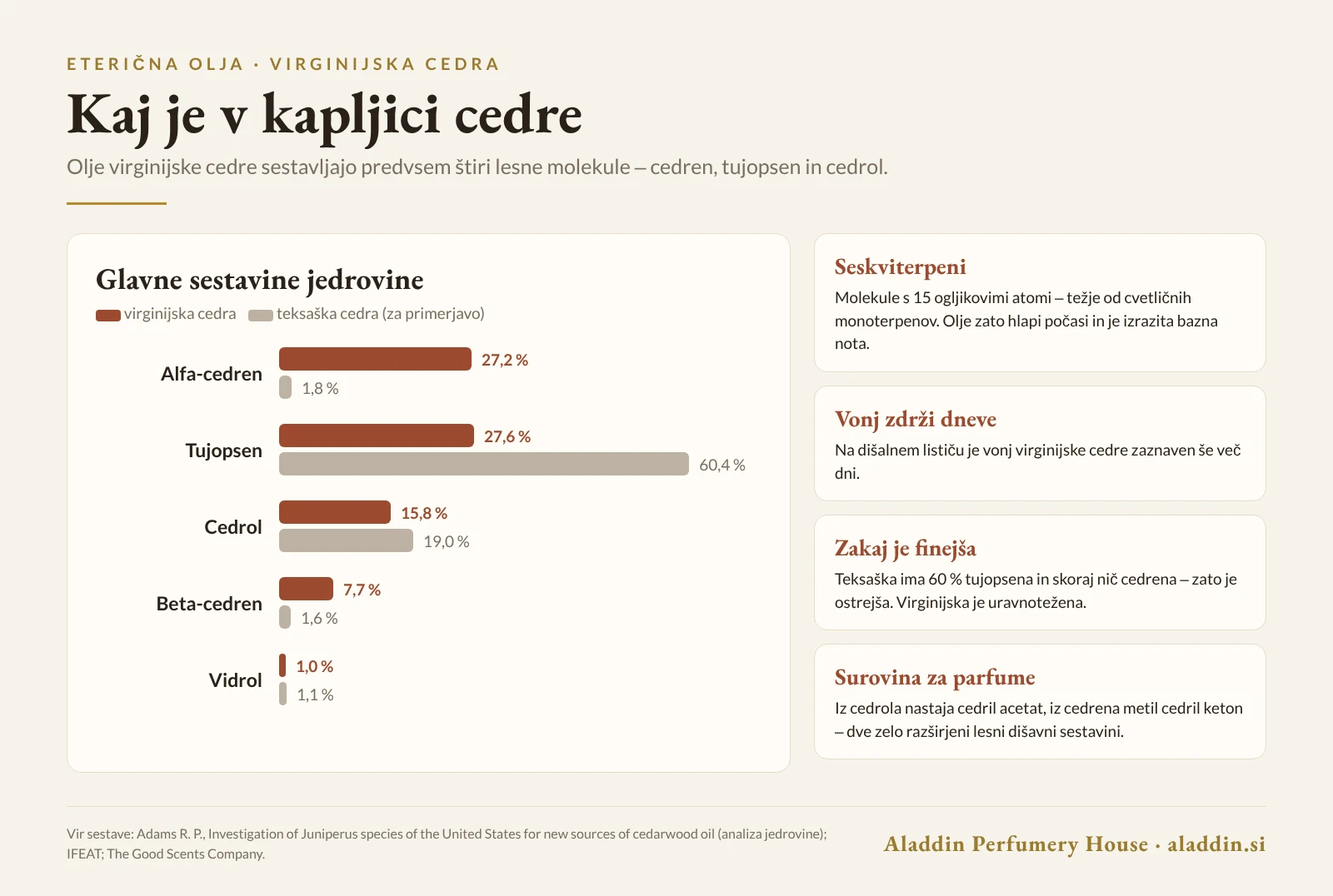
Virginia cedarwood oil is very different from floral oils. Instead of light, fast-evaporating monoterpenes, it consists of heavier molecules with 15 carbon atoms – sesquiterpenes. That’s why the oil is thicker, evaporates slowly and the scent lasts a very long time: on a smelling strip it can still be detected for several days.
An analysis of the heartwood showed that it consists mainly of four compounds:
- alpha-cedrene (about 27%) – a dry, woody scent we associate with pencils,
- thujopsene (about 28%) – a woody, slightly camphoraceous tone,
- cedrol (about 16%) – a solid, crystalline alcohol with a soft, warm woody scent; the most researched component of the oil,
- beta-cedrene (about 8%).
A comparison with Texas cedarwood neatly shows why Virginia is considered finer. Texas cedarwood contains as much as 60% thujopsene and almost no alpha-cedrene, so its scent is sharper and smokier. Virginia has a balanced ratio, so its scent is softer and “cleaner”.
What Virginia cedarwood smells like
Like a freshly sharpened pencil – a description even perfumers use. The scent is dry, woody and warm, with a slightly sweet, balsamic and ambery note in the background. It isn’t resinous like pine or spruce, nor sweet like sandalwood; it is calm, clean and unobtrusive. The oil is pale yellow and slightly thicker than floral oils.
In perfumery cedarwood is a classic base note. It provides the foundation that “holds” top and heart notes on the skin and is one of the most common ingredients in woody, men’s and unisex fragrances. It pairs most beautifully with citrus, lavender, frankincense, conifers, patchouli and floral oils such as geranium.
Virginia cedarwood is the scent of a sharpened pencil and an old chest – dry, warm and calm.
Properties: what is proven, what has been studied and what is folk tradition
Once again we’ve sorted the properties by how well they are supported. What works in the laboratory doesn’t necessarily work in people, and folk tradition is part of the tree’s story, not instructions for treatment.

Studied in humans
- Calms the body. Japanese researchers had 26 healthy adults inhale cedrol, the main component of the oil. Compared with ordinary air, their heart rate, systolic and diastolic blood pressure and breathing rate all fell. Heart-rhythm analysis showed increased activity of the parasympathetic nervous system – the part responsible for rest (2003).
- Patchy hair loss. In a Scottish double-blind study (1998), 86 patients with alopecia areata massaged a blend of thyme, rosemary, lavender and cedarwood oils in a carrier oil into their scalp every day for seven months. 44% of patients in the essential oil group improved, compared with 15% in the control group, who received carrier oil only. Because a blend of four oils was used, we don’t know how much cedarwood itself contributed, and the study has never been repeated on a larger scale.
In the laboratory and in animals
- Ticks. In 2022 the US Department of Agriculture published a study in which a cedarwood oil extract repelled 80 to 94% of blacklegged tick nymphs – as effective as DEET for this species. For other tick species DEET was better.
- Insects, termites and fungi. Cedrol repels fire ants, and wood impregnated with the oil was more resistant to termites and wood-rotting fungi.
- Moths. The scent of cedarwood deters adult moths from laying eggs in fabric. It doesn’t kill larvae, and the effect fades over the years.
- Calming. In rats, inhaling cedrol reduced activity and had a calming effect (2003).
The US Environmental Protection Agency (EPA) officially lists Virginia cedarwood oil among minimum-risk active ingredients that may be used in insect-control products without special registration.
Folk tradition and aromatherapy
In aromatherapy cedarwood is regarded as a “grounding” oil that calms the mind, aids concentration and prepares for sleep. It is recommended for tension and restlessness, oily skin and scalp, dandruff and acne, easier breathing during colds and as a natural insect repellent. It is considered one of the most “masculine” essential oils, which is why it is a common ingredient in beard oils and aftershaves.
Native peoples used it for rheumatism and in purification rituals. People in the Ozark Mountains, on the other hand, believed that transplanting a cedar would bring death to the family and that cedar branches in the house brought bad luck – except at Christmas, when they had to be taken out of the house by Epiphany. In many American homes cedar was also the traditional Christmas tree.
Two myths you can safely forget
- “Virginia cedarwood oil is the oil of the biblical cedars of Lebanon.” Not true. The cedar of Lebanon (Cedrus libani) is a true cedar from the Middle East, while Virginia cedar is an American juniper. They belong to different families and their oils are also completely different in composition.
- “A cedar chest kills moths forever.” Cedarwood only deters moths and doesn’t kill larvae already in the fabric. The oil slowly evaporates from the wood, so the effect fades over the years. It helps to lightly sand the surface of the chest or to put a few drops of oil on wooden blocks.
You’ll also read online that cedarwood oil “releases melatonin”. There are no published studies supporting this claim. All that has been studied is that cedrol calms heart rate and breathing in people.
How we use cedarwood at home
Our Virginia cedarwood oil is intended for scenting rooms. It creates a calm, warm atmosphere suitable for the bedroom, study and living area. Because it evaporates slowly, it is an excellent base in blends, prolonging the scent of citrus and floral oils.
- Ultrasonic diffuser: 3–5 drops per 100 ml of water.
- Waterless nebuliser: pour the oil into the device’s bottle and screw it on.
- Scent stones, wooden beads or ceramics: 2–3 drops, repeat as needed.
- Wardrobe and drawers: 2–3 drops on a wooden block, a piece of untreated wood or a cotton cloth placed among your clothes – never directly on the fabric.
Air the room occasionally during use. For the living room the Urban diffuseris a lovely choice, and for the bedroom the Himalayan salt night light. You’ll find more about oils for winding down in the evening in the guide Which essential oil to use in the evening.
Six cedarwood blends for the diffuser
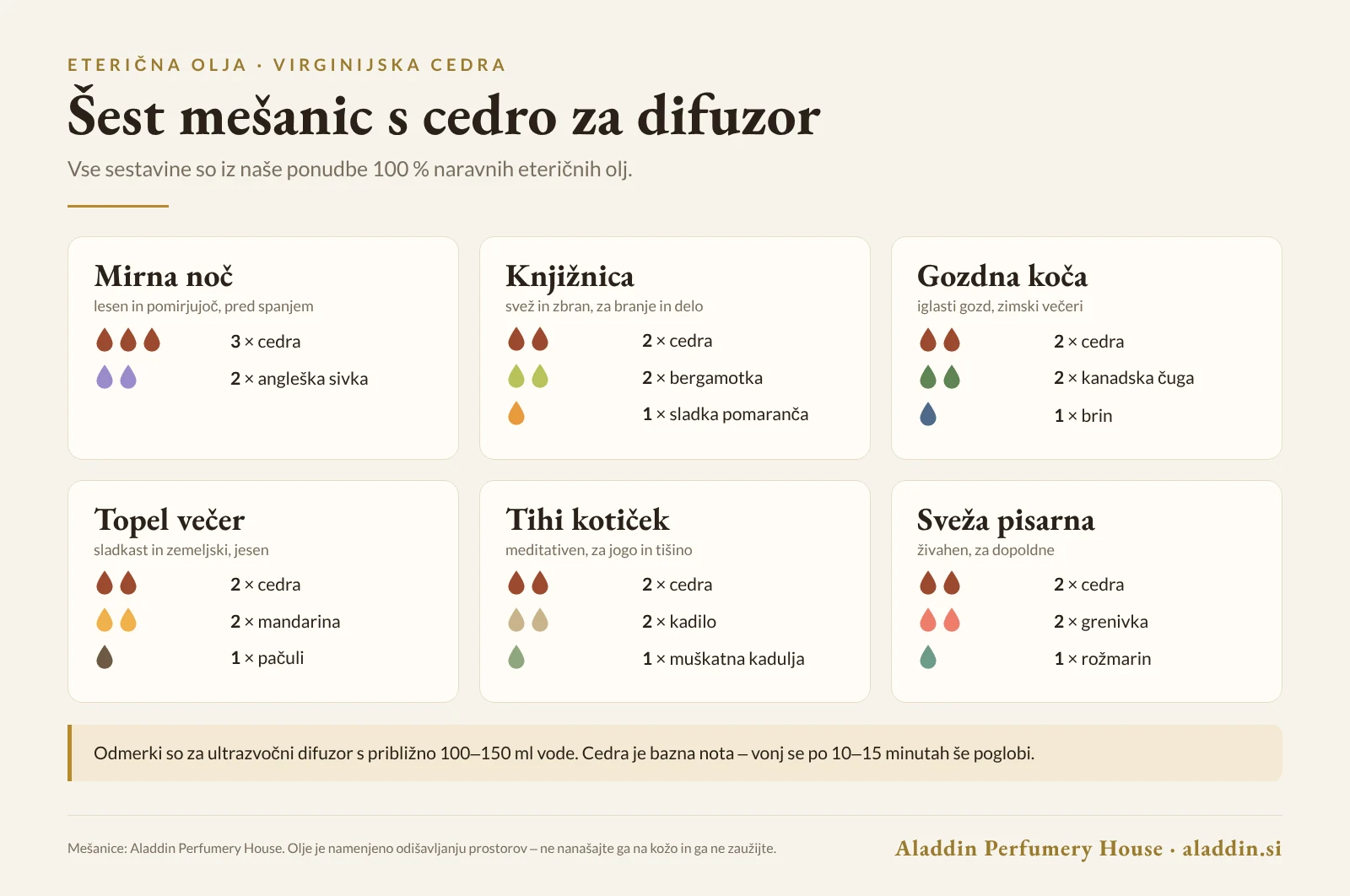
Cedarwood is remarkably versatile: with citrus it becomes fresh, with lavender calming, with conifers foresty and with frankincense meditative. The blends below are made exclusively from oils in our range, and the amounts are for an ultrasonic diffuser with about 100–150 ml of water.
| Blend | Ingredients (drops) | When |
|---|---|---|
| Peaceful Night | 3 cedarwood + 2 English lavender | before bed |
| Library | 2 cedarwood + 2 bergamot + 1 sweet orange | reading, work, study |
| Forest Cabin | 2 cedarwood + 2 Canadian hemlock + 1 juniper | winter evenings |
| Warm Evening | 2 cedarwood + 2 mandarin + 1 patchouli | autumn and winter evenings |
| Quiet Corner | 2 cedarwood + 2 frankincense + 1 clary sage | meditation, yoga |
| Fresh Office | 2 cedarwood + 2 grapefruit + 1 rosemary | morning and working day |
Tip: cedarwood is a base note, so it develops slowly. Let the blend work for a few minutes before adding more drops – after 10–15 minutes the scent deepens further.
 Virginia cedarwoodA dry, warm woody baseView product
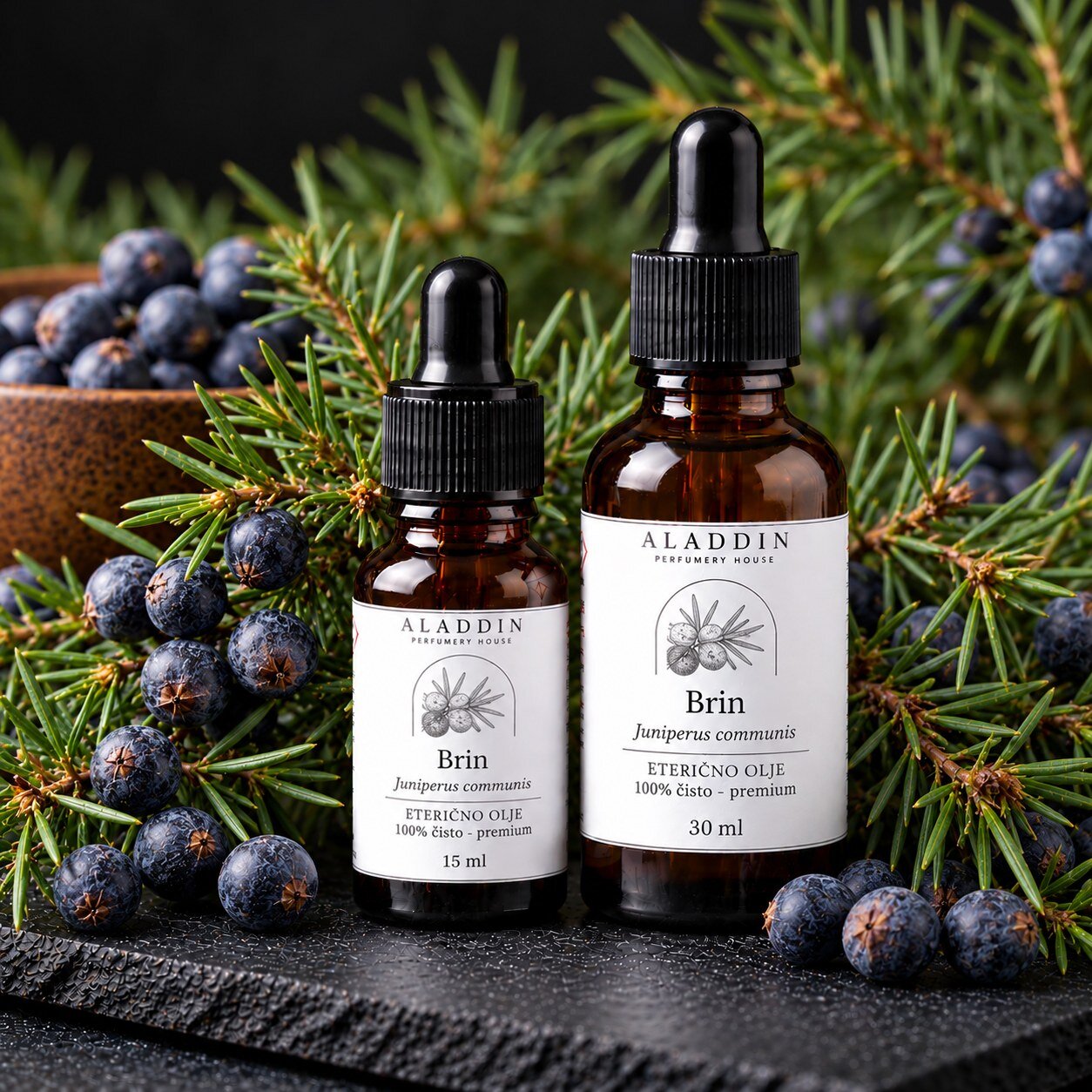 JuniperIts close relativeView product
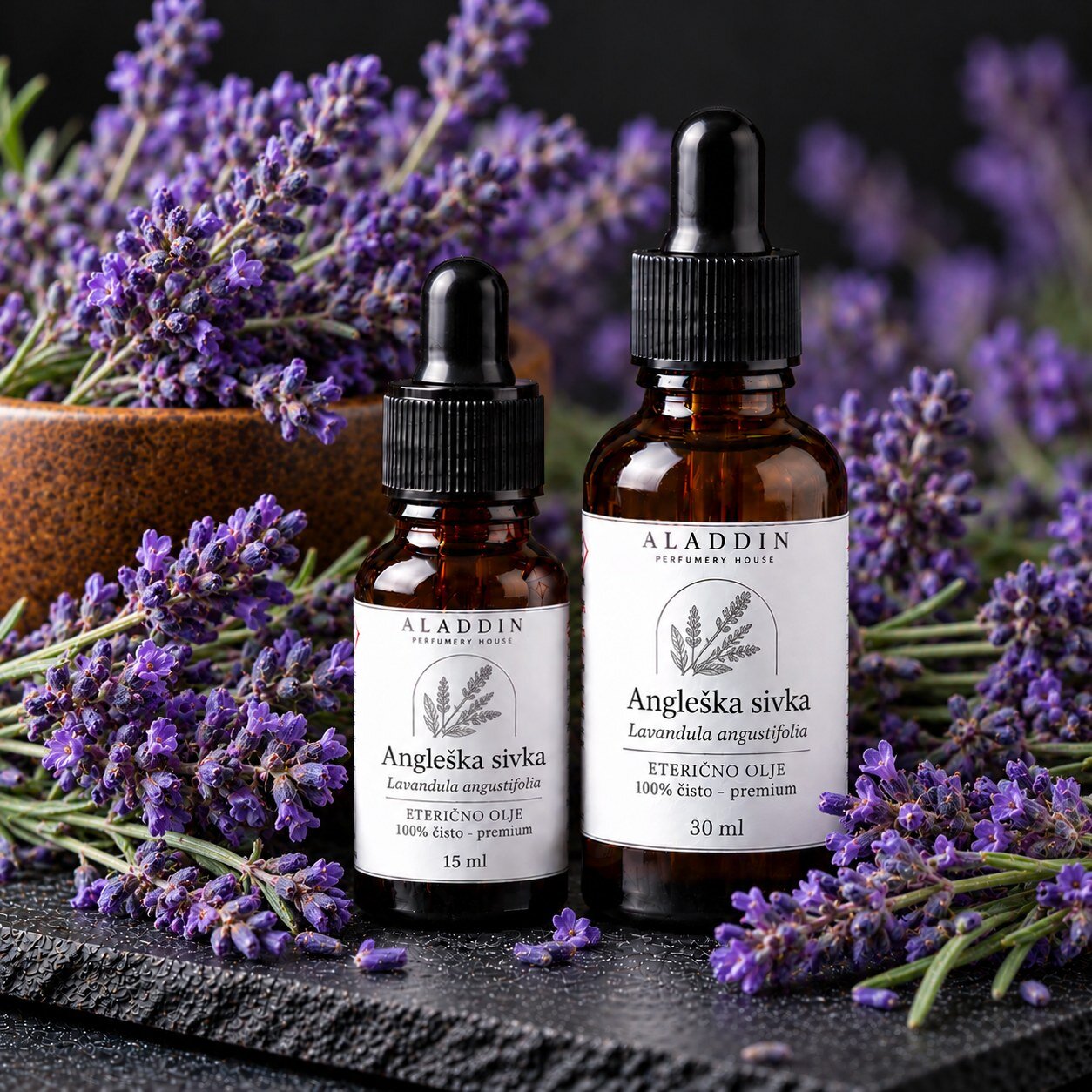 English lavenderThe perfect evening pairView product
Safe use – a few rules worth following
- Do not apply the oil to the skin and do not swallow it. Our oil is not a cosmetic product but a pure concentrate for scenting rooms.
- May be fatal if swallowed and enters airways. This is a property of sesquiterpenes, typical of wood oils. If someone swallows it by accident, do not induce vomiting and call a poison centre or doctor immediately. So always keep the bottle out of the reach of children.
- Pregnant and breastfeeding women and parents of very young children should consult a doctor before use. Do not use the diffuser in a room where a baby is sleeping.
- Pets: cats are especially sensitive to essential oils. While the diffuser is running, the animal should always be able to go to a scent-free room.
- The oil is very toxic to aquatic organisms, so don’t pour leftovers down the drain.
- Keep the bottle tightly closed in a cool, dark place.
- Aromatherapy does not replace medical treatment. If you have health problems, consult a doctor.
A safety data sheet is available for every oil and we will email it to you on request. You can view the label with all warnings on the product page.
Frequently asked questions
Is Virginia cedar a true cedar?
No. Botanically it is a juniper (Juniperus virginiana) of the cypress family. True cedars (Cedrus) belong to the pine family and grow in the Mediterranean and the Himalayas.
What does Virginia cedarwood oil smell like?
Dry, woody and warm – like a sharpened pencil or an old wooden chest, with a slightly sweet, ambery note.
Does cedarwood oil repel moths?
Cedarwood scent deters adult moths from laying eggs. It doesn’t kill larvae, and the effect fades as it evaporates, so the scent needs to be refreshed regularly.
What’s the difference between Virginia and Atlas cedarwood?
Virginia cedar is an American juniper with a dry pencil scent; Atlas cedar is a true cedar from Morocco with a warmer, sweetish and balsamic scent. The oils have completely different compositions.
Can I use cedarwood oil for hair or skin?
Our oil is intended for scenting rooms and is not a cosmetic product. For skin and hair care, choose a product designed and safety-assessed for that purpose.
Which oils does cedarwood pair with best?
With bergamot and other citrus oils, lavender, frankincense, conifers such as Canadian hemlock and juniper, and with patchouli and geranium.
How many drops of cedarwood oil should I put in the diffuser?
For an ultrasonic diffuser, 3–5 drops per 100 ml of water. Start with less and increase the amount if needed.
A tree with a long memory
Virginia cedar is a tree that history has renamed several times and almost exhausted – yet it has always sprung back. It was the sacred tree of native peoples, the wood of the best pencils and the guardian of trousseaus in chests, and today its scent comes in a bottle made from wood that would otherwise have been left at the sawmill.
If you’d like to get to know it, start simply: put three drops of cedarwood and two drops of lavenderin your diffuser. You’ll find the whole range in the Natural essential oilscategory. In the first part of the series we introduced geranium, and we described how essential oils are made and how to recognise good quality in the article Essential oils: from plant to bottle.
In the next part of the series we’ll introduce another oil from our range. If you have a question, write to us or give us a call – we’re happy to advise.
Sources
- Adams R. P.: Investigation of Juniperus species of the United States for new sources of cedarwood oil – Economic Botany
- IFEAT: Socio-economic report – Cedarwood oils
- dsm-firmenich: Cedarwood Virginia USA – cultivation and raw material
- Dayawansa S. et al. (2003): Autonomic responses during inhalation of natural fragrance of Cedrol in humans – Auton Neurosci
- Kagawa D. et al. (2003): The sedative effects of cedrol inhalation – Planta Med 69(7)
- Hay I. C. et al. (1998): Randomized trial of aromatherapy – successful treatment for alopecia areata – Arch Dermatol
- USDA ARS (2022): Pleasant-smelling wood oil not so pleasant for biting ticks
- Missouri Department of Conservation: Eastern red cedar
- Bugwood Wiki: Eastern redcedar (Juniperus virginiana)
- Wikipedia: Musgrave Pencil Company
- NativeTech: Cedar – Native American uses
- Inverse: The science of cedar as a moth repellent
- US EPA, 40 CFR 152.25(f): Minimum risk pesticides – permitted active ingredients


