

Blog
Essential oils: from plant to bottle


When you open a bottle of good essential oil, the scent is not just pleasant – it is alive. Fresh orange smells like fruit that has just been peeled, conifers like a forest after rain. Yet the same oil can lose this freshness after a few months in the wrong place. In this article we show you how essential oils are made, where ours come from, how to recognise quality and why at Aladdin Perfumery House we prefer working in smaller batches rather than with large stocks.
What an essential oil actually is
An essential oil is a mixture of volatile fragrant substances that a plant stores in its leaves, flowers, fruit peel, wood or resin. Despite the name, it is not an “oil” in the kitchen sense of the word: it contains no fats, so it leaves no greasy mark on paper but evaporates.
The international standard ISO 9235 only counts as an essential oil a product obtained by steam distillation, dry distillation or mechanical expression of citrus peel. Fragrant extracts obtained with solvents (absolutes, such as jasmine) or with carbon dioxide (CO₂ extracts) can be excellent, but strictly speaking they are not essential oils.
How they are obtained
Steam distillation
This is the most common method. Plant material – leaves, flowers, wood or resin – is loaded into a still, and hot steam is passed through it. The steam releases the volatile fragrant substances from the plant cells and carries them away. In the condenser the steam and oil condense, and in the collecting vessel the oil, which does not mix with water, separates from it. The water that remains is the hydrolate – a delicate floral or herbal water.
Distillation takes experience. Too short, and it does not capture the heavier, deeper notes; too long and too hot, and it can “cook” the scent. Wood and resins are distilled much longer than leaves and flowers. This is how most of our oils are made: from tea tree and eucalyptus to cedarwood, frankincense and geranium.
Cold pressing of the peel
Citrus oils – orange, mandarin, lemon, grapefruit and bergamot – are stored in tiny oil glands in the peel. These are opened by mechanical pressing without heat, and the oil is then separated from the juice and water in a centrifuge. Because no heat is involved, the scent stays juicy and sparkling, just as we know it from freshly peeled fruit.
Much of the world’s orange oil is produced alongside orange juice, mostly in Brazil. That is why orange oil is one of the most affordable essential oils – which does not mean it is worth any less.
How much plant goes into one bottle
The yield varies greatly from plant to plant. 100 kg of eucalyptus leaves give 3 to 4 kg of oil, while the same amount of frankincense resin gives only about 0.4 kg. Rose is the extreme case: one kilogram of oil requires 3.5 to 5 tonnes of petals.
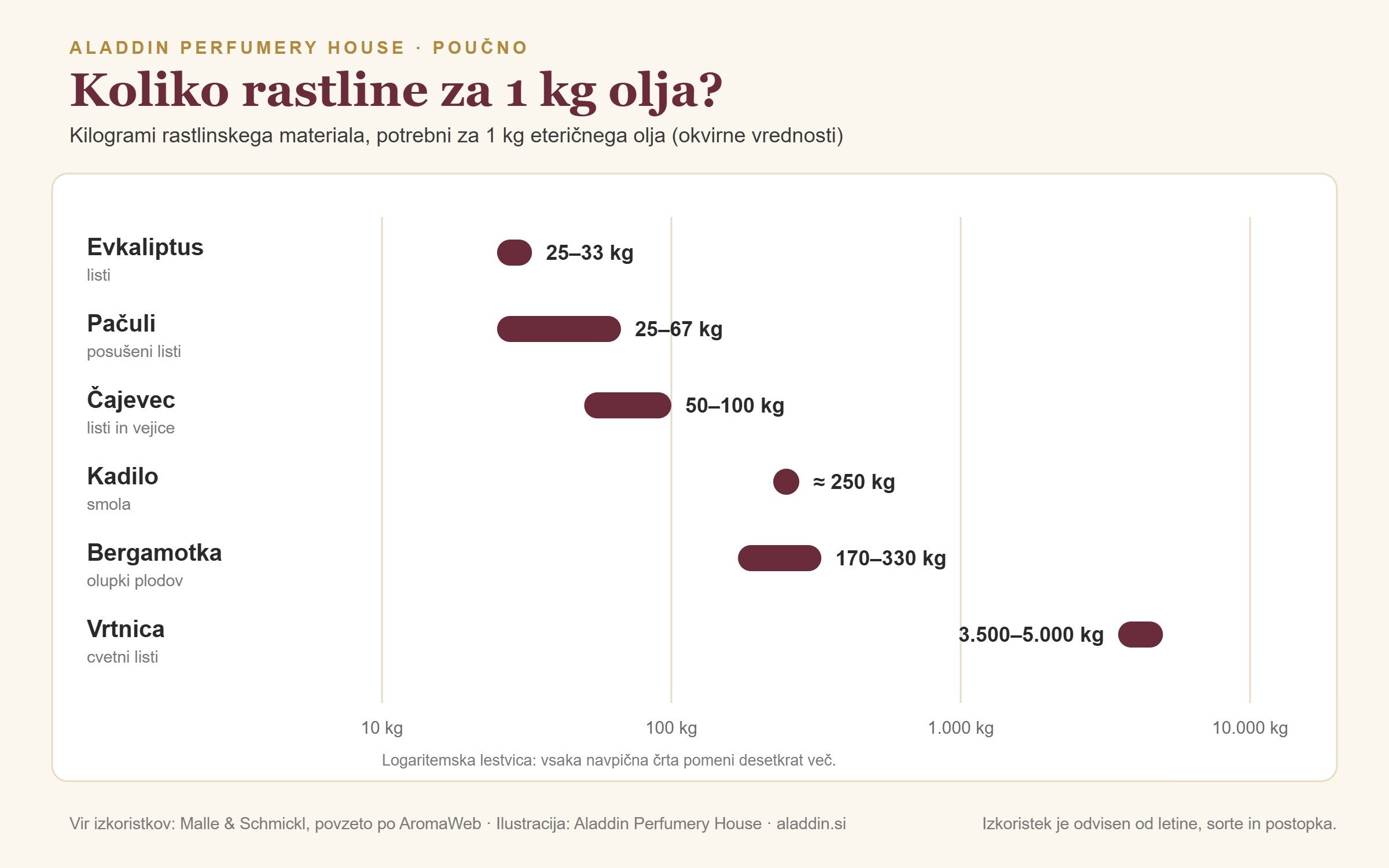
What does this tell us about price?
The price of an essential oil primarily reflects how much plant material and work goes into it – not necessarily its quality. A cheap oil is not automatically a bad one. A surprisingly cheap “expensive” oil, such as rose or frankincense, however, is a reason for caution.
Where our oils come from
The same plant smells different when it grows on the other side of the world. Climate, altitude, soil and harvest time all affect the composition of the oil, which is why we give the Latin name and country of origin for every oil. Most of our oils come from places where the plant traditionally thrives: tea tree from Australia, where it originates, lavender from France, cinnamon from Sri Lanka, ylang ylang from the Comoros, frankincense from Somalia and juniper from the mountains of North Macedonia.
Already available
| Oil | Latin name | Country of origin | Plant part | Extraction |
|---|---|---|---|---|
| Tea tree | Melaleuca alternifolia | Australia | leaves and twigs | steam distillation |
| Lemongrass | Cymbopogon citratus | Guatemala | leaves | steam distillation |
| Eucalyptus | Eucalyptus globulus | China | leaves and twigs | steam distillation |
| Bergamot | Citrus bergamia | Ivory Coast | fruit peel | cold pressing |
| Sweet orange | Citrus sinensis | Brazil | fruit peel | cold pressing |
| Virginia cedarwood | Juniperus virginiana | USA | wood | steam distillation |
| Frankincense | Boswellia carterii | Somalia | resin | steam distillation |
| Geranium | Pelargonium graveolens | Egypt | leaves, stems, flowers | steam distillation |
Coming soon
| Oil | Latin name | Country of origin | Plant part | Extraction |
|---|---|---|---|---|
| Lavender | Lavandula angustifolia | France | flowering tops | steam distillation |
| Peppermint | Mentha × piperita | India | flowering herb | steam distillation |
| Rosemary | Rosmarinus officinalis | Spain | flowering tops | steam distillation |
| Red thyme | Thymus vulgaris | Spain | leaves | steam distillation |
| Lemon | Citrus limon | Italy | fruit peel | cold pressing |
| Mandarin | Citrus nobilis | Italy | fruit peel | cold pressing |
| Grapefruit | Citrus paradisi | USA | fruit peel | cold pressing |
| Cinnamon (leaf) | Cinnamomum zeylanicum | Sri Lanka | leaves and twigs | steam distillation |
| Clove (leaf) | Eugenia caryophyllata | Madagascar | leaves | steam distillation |
| Star anise | Illicium verum | China | fruits | steam distillation |
| Scots pine | Pinus sylvestris | Siberia | needles | distillation |
| Hemlock spruce | Tsuga canadensis | USA | needles and twigs | steam distillation |
| Juniper | Juniperus communis | North Macedonia | berries | steam distillation |
| Patchouli | Pogostemon cablin | Indonesia | dried leaves | steam distillation |
| Ylang ylang | Cananga odorata | Comoros | flowers | steam distillation |
Frankincense will soon also be available as a 100% pure essential oil. The current 5% blend of frankincense in grapeseed oil remains available among the scented blends.
How to recognise a quality essential oil
- Latin name and country of origin. “Lavender” can be true lavender (Lavandula angustifolia) or the cheaper lavandin – the scent and composition differ. Without the Latin name you do not know what you are buying.
- One plant, 100%. No synthetic fragrances, no “stretching” with cheaper oils or a carrier oil. If an oil is diluted, this must be clearly stated – as with our 5% frankincense blend.
- Dark glass. Light accelerates the ageing of oil, and essential oils also break down some plastics. Brown glass is a basic requirement.
- Correct labelling. Pure essential oils are concentrated substances, so they must carry a label in line with the CLP Regulation: pictograms, hazard and precautionary statements and supplier details. An oil without this information is a warning sign.
- Batch number (LOT) and expiry date. They allow traceability from the bottle back to the source.
- International standards. For most of the more important oils there are ISO standards that set the limits within which the composition must lie – for example ISO 4730 for tea tree.
Myth: “therapeutic grade”
The label “therapeutic grade” is not official. It is a marketing term with no independent standard or oversight behind it. The Latin name, origin, batch number and a correct label tell you far more.
Freshness – what you cannot see on the label
An essential oil does not stay the same. Once it comes into contact with oxygen, it slowly begins to change, and heat and light speed this up. Oils rich in light terpenes oxidise fastest – above all citrus oils and conifer oils.
It is not only the scent that changes, losing its sparkle and becoming sharp or “turpentine-like”. During oxidation, some components, such as limonene and linalool, form hydroperoxides, which are much stronger skin allergens than the original substances. An old, oxidised oil is therefore worse for the scent and also less kind to the skin.
There are exceptions too. Patchouli and similar woody and resinous oils can even deepen and become rounder over time when stored correctly – much like a good wine.
Why mass production is not always an advantage
Big brands buy oil in drums of several hundred kilograms at a time. The oil then travels through a long chain: from the distillery to the wholesaler, the filling plant, the central warehouse, the shop and finally the shelf, often under bright lighting and at room temperature or higher. Every time a drum is opened and every day spent in the warm means a little more oxygen and a little less freshness. The customer cannot see this on the bottle.
How we do it
- Smaller quantities. We buy oils in quantities we can use within a reasonable time, instead of building up large stocks.
- Filled in Slovenia. We fill the bottles ourselves, in smaller batches, so the oil does not sit for long in half-empty containers.
- Brown glass and a good seal. From filling to your home, the oil is protected from light and air.
- Traceability. Every batch has its own LOT number linked to the manufacturer’s batch, so we can trace every bottle back to its source.
- Cards on the table. You can view the label with all the safety information on the product page before you even buy the oil.
How to store oil at home
- Close the bottle tightly immediately after use.
- Keep it in a dark, cool place – not on a windowsill, not next to a radiator and not in the bathroom.
- Less air in the bottle means slower oxidation. That is why a smaller bottle that you use up faster is often a better choice than a large one you open for months.
- Use citrus and conifer oils first. In the fridge, in a closed container and away from food, they stay fresh longer.
- Star anise can solidify or crystallise at lower temperatures. This is not a defect – at room temperature the oil becomes liquid again.
- Always keep oils out of reach of children and pets.
Scents through the year
Autumn brings warm, woody and earthy scents: cedarwood, patchouli, rosemary and lemongrass.
December smells of orange, mandarin, cinnamon, cloves and star anise, of a conifer forest – Scots pine, hemlock spruce and juniper – and of frankincense.
Spring calls for freshness: lemon, grapefruit, bergamot, lavender, peppermint, geranium and floral ylang ylang.
A few simple blends for an ultrasonic diffuser (per 100 ml of water)
- Festive evening: 3 drops of sweet orange, 1 drop of cinnamon, 1 drop of clove
- Winter forest: 2 drops of Scots pine, 2 drops of hemlock spruce, 1 drop of juniper
- Autumn retreat: 3 drops of Virginia cedarwood, 1 drop of patchouli, 1 drop of orange
- Spring morning: 3 drops of lemon, 2 drops of grapefruit, 1 drop of peppermint
Cinnamon and clove are very intense, so dose them sparingly. Start with fewer drops and add more if needed.
Less, but fresh
A good essential oil is not necessarily the one from the biggest factory or with the loudest label. It is the one with a clear origin, a correct label and that reaches you fresh. That is why we prefer to fill less and more often – so that when you open the bottle, the scent stays just as the plant gave it.
👉 Natural essential oils in 15 ml and 30 ml bottles
Essential oils are not intended for ingestion and should not be applied undiluted to the skin. They are not medicines and do not replace medical advice. Read the warnings on the label before use.


